

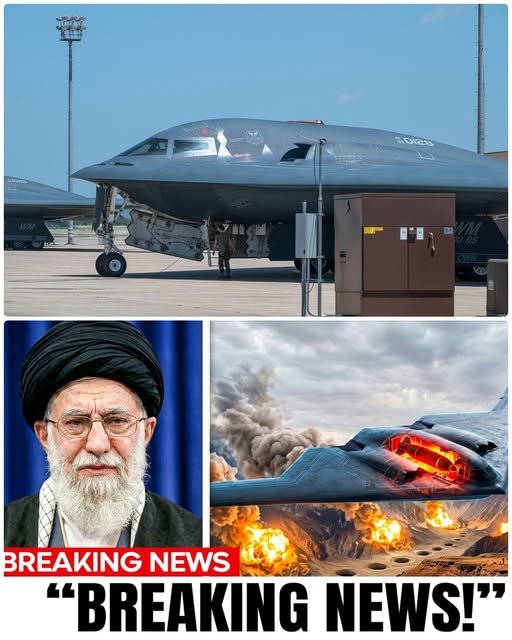
At approximately 2:17 a.m.
Eastern Time — or, as Twitter prefers to call it, “World War O’Clock” — the internet erupted with a headline so dramatic it practically came with its own soundtrack: “B-2 Bombers OBLITERATE Iran’s Underground Bases — Largest Strike in History.”
Obliterate.
Underground.
Largest.
In history.
That’s not a news alert.
That’s a movie trailer.
Within minutes, grainy night-vision clips, stock footage of stealth bombers gliding like gothic birds across moonlit skies, and ominous voiceovers flooded social feeds.
Commentators declared it a “turning point.
” Influencers labeled it “shock and awe 2.0.”

Conspiracy accounts confidently announced “global escalation inevitable.”
And somewhere, an exhausted defense analyst quietly muttered, “Can we maybe read past the headline first?”
Let’s unpack what actually happened, what didn’t happen, and why the mere mention of a B-2 Spirit bomber tends to make the entire internet drop its coffee.
The Stealth Star of the Show
If military hardware had celebrity status, the B-2 Spirit would be the brooding A-list actor who rarely gives interviews but commands attention every time it appears.
Developed during the Cold War, the B-2 is famous for its flying-wing design, radar-evading stealth, and its ability to carry heavy precision munitions over intercontinental distances without refueling theatrics.
It doesn’t roar.
It glides.
It whispers.
And then, apparently, it “obliterates.”
The bomber is capable of carrying the GBU-57 Massive Ordnance Penetrator — a 30,000-pound bunker-buster specifically designed to target deeply buried, reinforced facilities.
The mere suggestion that such munitions were deployed against “underground bases” is enough to set off a thousand speculative threads about secret tunnels, fortified command centers, and cinematic underground labyrinths.
Which brings us to the claim: largest strike in history.
“Largest Strike” — According to Whom?
Whenever you see “largest strike in history,” your first instinct should be to ask: in history of what, exactly?
Largest use of B-2s in a single mission?
Largest bunker-buster deployment?
Largest strike on underground facilities?
Largest headline font size?
Modern conflicts are notoriously layered with psychological signaling.
Announcements of scale often serve deterrent messaging as much as they describe literal tonnage dropped.
If B-2 bombers were indeed deployed in significant numbers against fortified Iranian targets, that is unquestionably serious.
These aircraft are not routine show-and-tell props.
They are strategic assets reserved for high-value missions.

But “largest in history” is a phrase that demands context — and context rarely trends as well as “OBLITERATE.
”
The Underground Angle
Iran has long invested in hardened and underground military infrastructure.
From missile storage facilities carved into mountainsides to fortified command bunkers, the country’s defense doctrine assumes that adversaries possess overwhelming airpower.
The solution? Go deep.
Underground facilities are designed to survive conventional airstrikes.
They rely on reinforced concrete, rock overburden, and layered protection.
Enter the bunker-buster narrative.
When headlines suggest B-2 bombers targeted underground bases, the implication is clear: this was not symbolic.
This was surgical.
This was aimed at assets thought to be secure beneath layers of earth and steel.
Cue the dramatic music.
Social Media’s Immediate Reaction
Within moments of the reports, social platforms did what they do best: accelerate.

Hashtags trended globally.
Armchair strategists began posting satellite screenshots.
One viral thread claimed, without evidence, that “entire mountains collapsed.
”
Meanwhile, a YouTube livestream titled “Global War Watch” attracted hundreds of thousands of viewers in under an hour.
The comment sections ranged from anxious to apocalyptic.
“This is it.”
“Oil markets will explode.”
“Brace for retaliation.”
Calm voices were present, but they were drowned out by digital adrenaline.
What Is Actually Confirmed?
Publicly available information at the time of such reports tends to be limited.
Military operations involving stealth bombers are not livestreamed with helpful captions.
Typically, confirmation comes in stages:
Official acknowledgment of strikes.
Statements describing targets in broad terms.
Satellite imagery analysis over subsequent days.
Initial claims of “obliteration” often precede detailed damage assessments.
History teaches us that underground facilities can be heavily damaged without being entirely destroyed.
Hardened structures are built precisely to absorb impact.
So while bunker-buster munitions can penetrate deeply, definitive claims of total annihilation are difficult to verify in the immediate aftermath.
But that has never stopped the headline machine.
Why the B-2 Changes the Tone
The use of stealth bombers elevates perception.
Fighter jets are common in modern conflicts.
Cruise missiles are frequent.
Drones are routine.
The B-2 is different.
It signals strategic intent.
It implies premeditation, long-range planning, and significant stakes.
Deploying it is not casual.
That’s why the internet reacts as if a chessboard just flipped over.
The Geopolitical Powder Keg
Iran occupies a central role in Middle Eastern geopolitics.
Any direct large-scale strike on its territory risks escalation.
Regional actors watch closely.
Energy markets react quickly.
Diplomatic channels buzz frantically.
Even if the strike was limited to specific military facilities, the symbolism alone carries weight.
Retaliation scenarios are immediately debated: missile launches, proxy actions, cyber operations.
The phrase “largest strike in history” becomes less about tonnage and more about signaling dominance.
The Over-the-Top Expert Panel
No tabloid moment is complete without dramatic “expert” commentary.
One television analyst proclaimed, “This fundamentally reshapes deterrence dynamics in the region.
”
A former defense consultant told viewers, “When stealth bombers move, it’s because someone wants to send a message written in concrete dust.
”
A social media influencer declared, “Mountains are not safe anymore.
”
Measured? Not exactly.
Engaging? Absolutely.
The Reality of Underground Warfare
Destroying underground facilities is complex.
Even advanced munitions may require multiple passes to achieve full structural compromise.
Damage assessments rely on satellite imagery, seismic readings, and intelligence reports.
Claims of total obliteration often soften over time as more information emerges.
That doesn’t mean the strike was insignificant.
It means war rarely conforms to headline simplicity.
Economic Shockwaves
Markets do not wait for confirmation.
Oil futures react to perception.
The mere suggestion of large-scale military escalation involving Iran can trigger price volatility.
Energy analysts begin forecasting supply disruptions.
Traders watch the Strait of Hormuz nervously.
Politicians issue carefully worded statements urging restraint.
Even if no further escalation occurs, the psychological ripple travels fast.
The Dramatic Twist
Here’s the twist rarely acknowledged in viral threads: strategic strikes are often designed to avoid full-scale war.
Precision operations can serve as deterrence — a show of capability intended to prevent broader confrontation.
The paradox of military power is that sometimes it is deployed not to escalate, but to contain.
Of course, that nuance rarely fits inside a trending hashtag.
“Obliterate” vs. “Degrade”
In defense terminology, words matter.
“Obliterate” is cinematic.
“Degrade capability” is bureaucratic.
The former implies irreversible destruction.
The latter implies reduction in effectiveness.
In many cases, military strikes aim to degrade rather than annihilate — to disrupt operations, destroy specific assets, and send a strategic message.
But “degrade” does not break the internet.
“OBLITERATE” does.
The Human Factor
Lost in the spectacle are the people living near targeted areas.
Civilian safety, collateral damage concerns, and regional stability remain central issues.
While military targets may be underground and fortified, surrounding communities are not abstract chess pieces.
That complexity deserves attention beyond dramatic aerial stock footage.
Could This Escalate?
Yes.
Could it de-escalate? Also yes.
History shows cycles of action and response in the region.
The difference lies in scale, messaging, and restraint.
The presence of B-2 bombers raises the perceived ceiling of escalation.
But perception does not guarantee outcome.
Diplomatic channels often intensify after high-profile strikes.
The Psychology of Power Projection
Strategic bombers carry symbolic weight.
They represent technological dominance and long-range reach.
Deploying them is as much about narrative as it is about munitions.
In modern warfare, narrative is half the battle.
And in the age of social media, narrative travels faster than aircraft.
Final Shockwave
So did B-2 bombers strike underground Iranian facilities? Reports indicate significant operations targeting hardened sites.
Was it the “largest strike in history”? That depends on definitions and context.
Was everything “obliterated”? Damage assessments will tell that story over time.
What is certain is this: the moment stealth bombers enter the headline, global attention follows.
The internet amplifies.
Markets react.
Diplomats mobilize.
And somewhere, beneath layers of reinforced concrete and geopolitical tension, the world waits to see what comes next.
Because in modern conflict, the loudest explosion is often the headline itself.