Anna Coleman Ladd was not a soldier, a politician, or a battlefield photographer. She was an American sculptor who used her artistic talent for something far more personal: helping World War I soldiers who had suffered devastating facial injuries. Through carefully crafted prosthetic masks, she attempted to restore something that war had taken away—the appearance of a familiar face, and perhaps a measure of confidence in returning to ordinary life. Yet her work was only one small part of a much larger story preserved in old photographs. Across these images are ruined cities, soldiers, children, workers, artists, prisoners, families, inventions, and ordinary people caught in extraordinary times. Each photograph seems to ask the same question: what was it really like to live through the moments that later became history?
Anna Coleman Ladd’s work revealed a side of the First World War that battlefield maps could never show.
The war left countless soldiers with injuries that medicine at the time struggled to repair. Facial wounds could change not only a person’s appearance, but also the way they were treated by society after returning home.
Ladd used sculpture to create custom facial prostheses, carefully shaped to resemble the features of the men who wore them. Her work stood at an unusual intersection of art, medicine, and compassion.
The masks could not erase what had happened.
They could not return the men to the people they had been before the war.
But they could help some of them face the world again.
And that is one of the realities often overlooked when wars are remembered.
A war does not necessarily end when the fighting stops.
For many survivors, it continues through injuries, memories, and the difficult process of rebuilding an ordinary life.
In 1945, another photograph captured a moment that no form of medical reconstruction could undo.

Only minutes after the atomic bomb exploded over Nagasaki, Japan, the city had been transformed by unprecedented destruction.
This was not simply another conventional battlefield attack. The bombing of Nagasaki on August 9, 1945, followed the atomic bombing of Hiroshima three days earlier and became one of the defining moments of the Second World War and the beginning of the nuclear age.
Images of Nagasaki remain difficult to comprehend because they show how an entire urban environment could be transformed within an extraordinarily short period.
Buildings.
Streets.
Lives.
Everything existed within the consequences of a weapon whose destructive power had previously been unimaginable.
At almost the same time in Europe, another tragedy was reaching its final stages.
In 1944, Hungarian Jews were deported to Auschwitz-Birkenau, where many were murdered in gas chambers as part of Nazi Germany’s systematic genocide of European Jews.
This was not simply a consequence of a battlefield.
It was a deliberate campaign of persecution, deportation, and mass murder organized by the Nazi regime and its collaborators.
Photographs from Auschwitz and other concentration and extermination camps cannot restore the voices of every victim.
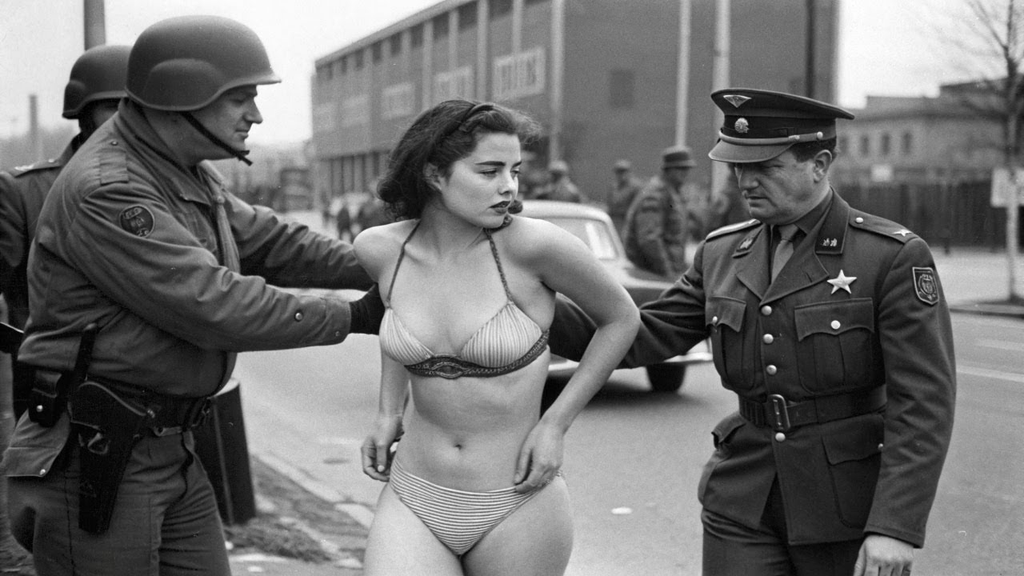
But they preserve physical evidence of what happened.
That is why such images matter.
They are not valuable because they shock us.
They are valuable because they prevent history from becoming an abstraction.
Then, decades later, a very different photograph captured another kind of historical confrontation.
In 1991, Princess Diana was photographed shaking hands with a person living with AIDS without wearing gloves.
Today, the gesture may appear completely ordinary.
At the time, it carried a very different meaning.
During the early years of the HIV/AIDS epidemic, misinformation and fear had contributed to widespread stigma against people living with the disease. Diana’s public interactions with patients helped challenge the idea that ordinary physical contact was dangerous.
There was no battlefield in the photograph.
No weapon.
No explosion.
Just a hand extended toward another person.
Sometimes a small gesture can challenge a very large misconception.
In 1945, members of the Danish resistance were photographed after managing to capture and disarm German soldiers. The moment reflected the changing balance of power as German occupation across Europe began to collapse.
Elsewhere, the war continued at sea.
On March 22, 1942, during the Second Battle of Sirte, HMS Cleopatra used smoke to help protect the convoy while HMS Euryalus brought its 5.25-inch guns into action against the Italian fleet.
A photograph of a warship in such circumstances can make naval warfare appear almost mechanical.
Steel.
Guns.
Smoke.
Distance.
But every vessel contained people.
Men had to make decisions in seconds, work under pressure, and trust equipment that could fail at the worst possible moment.
And then there was London.
On Christmas Day, December 25, 1940, people gathered for a Christmas party in an underground shelter.
Above them, London was enduring the Blitz.
The city had been subjected to sustained German bombing, yet below the streets people still attempted to celebrate Christmas.
That contrast is one of the most revealing aspects of wartime photographs.
War does not eliminate ordinary human behavior.
People still eat.
They celebrate birthdays.
They fall in love.
They tell jokes.
They try to create moments of normality.
Sometimes, maintaining a small piece of ordinary life is itself an act of endurance.
In 1946, Albert Einstein visited Lincoln University in Pennsylvania and delivered a lecture at the historically Black institution.
The visit took place in an America still deeply affected by racial segregation and discrimination.

Einstein had spoken publicly against racism in the United States, and his presence at Lincoln University reflected his engagement with social questions beyond theoretical physics.
Elsewhere in the same era, a photograph from the Atlantic Ocean showed German submarine crew members swimming beside their vessel.
It is an unexpectedly ordinary scene.
German submarines were instruments of war, but the men inside them were still human beings who needed moments of rest.
A submarine could spend long periods beneath the surface, isolated from the outside world.
For the men aboard, a brief swim in the ocean could momentarily transform the environment from a battlefield into something almost peaceful.
That contrast appears repeatedly in historical photography.
Machines belong to war.
People belong to life.
And sometimes the camera catches the moment when those two realities overlap.
In 1960, Japanese politics was shaken by the assassination of politician Inejiro Asanuma.
Some content was generated using AI tools (including ChatGPT) and edited by the author for creativity, storytelling, and historical illustration purposes. Historical facts and key details should be verified against reliable historical sources. Any AI-generated or reconstructed visuals are intended for illustrative purposes and should not be interpreted as original historical photographs or archival evidence.
Để lại một bình luận