

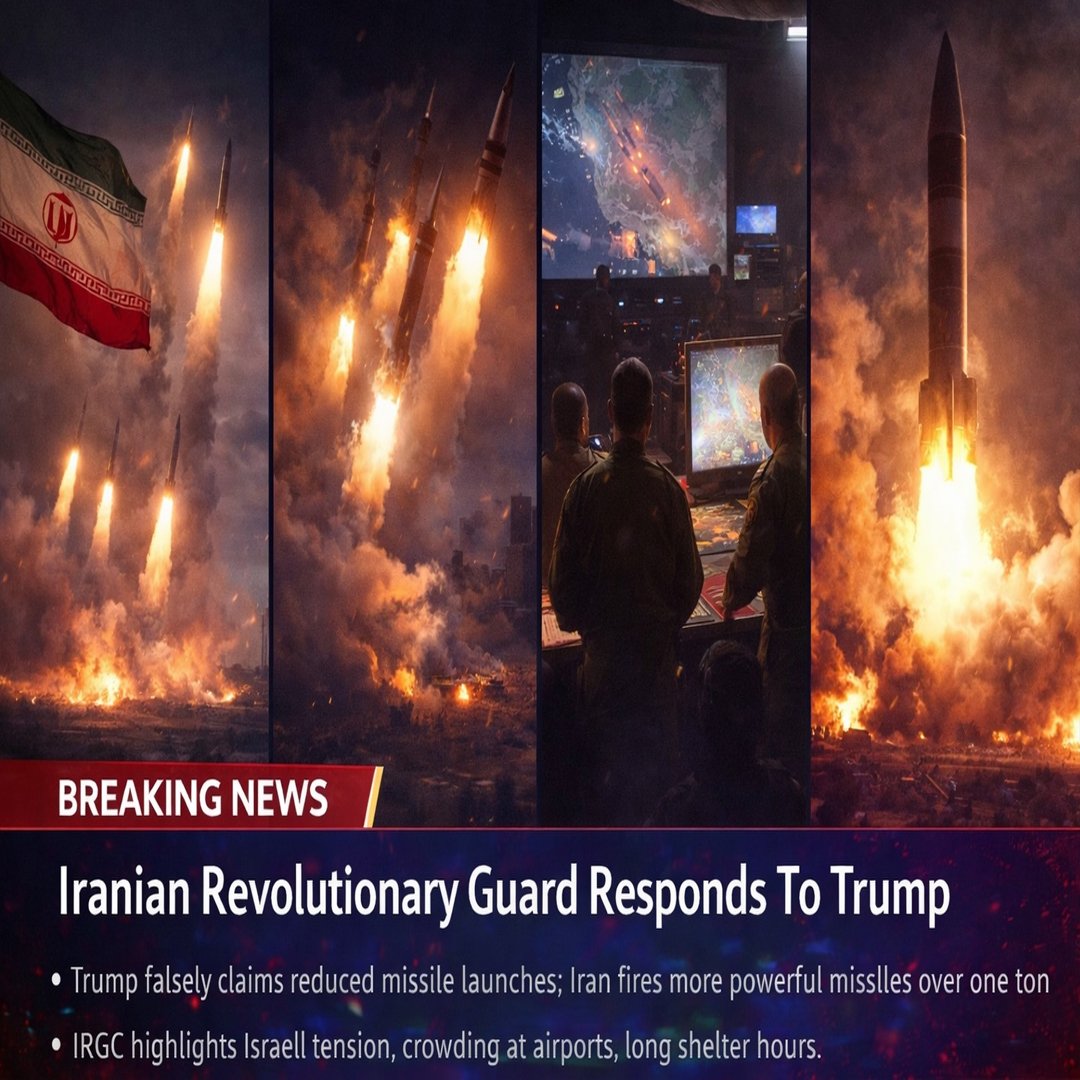
Iran Rejects Claims of Reduced Missile Activity
The Iranian Revolutionary Guard released a message claiming that reports of reduced Iranian missile launches were misleading.
According to the statement, the decrease in the number of missiles does not represent a weakening of Iran’s capabilities.
Rather, Iranian officials say the country has changed its tactical approach.
Instead of launching large numbers of smaller warheads, the IRGC claims it will deploy heavier and more destructive missile payloads designed to cause greater impact with each strike.
Iranian commanders argue this strategy increases both the range and destructive power of their arsenal.
“No Missiles Lighter Than One Ton”
One of the most striking parts of the statement came from the commander of the IRGC Aerospace Force, who reportedly declared that Iran would now launch missiles carrying warheads weighing more than one ton.
Military analysts say such warheads represent a dramatic increase in explosive power compared with many missiles previously used in regional conflicts.
A one-ton warhead can produce a massive blast radius capable of destroying reinforced structures, military installations, and infrastructure targets.
Iranian officials claim this change reflects a deliberate effort to increase the effectiveness of each launch, rather than relying on volume alone.
A Strategic Shift in the Conflict
Defense experts say the announcement could indicate a shift in Iran’s missile doctrine.
During the early stages of regional hostilities, Iran reportedly launched large waves of missiles and drones toward targets across the Middle East.
But as the conflict progressed, the pattern of launches appeared to change.
Instead of frequent mass volleys, Iran may now be prioritizing precision and destructive payload strength.
Analysts suggest this approach could help conserve Iran’s missile stockpiles while maintaining deterrence against adversaries.
Rising Regional Tensions
The statement from the Revolutionary Guard comes at a time of growing uncertainty across the region.
Recent weeks have seen escalating exchanges of threats, economic pressure, and military movements involving the United States and Iran.
Iran has also warned that continued attacks against its territory or strategic interests could lead to broader retaliation affecting regional security and energy routes.
Meanwhile, global markets and governments are closely watching developments, aware that any escalation between Washington and Tehran could quickly ripple across international politics and energy supplies.
The Message Behind the Statement
For Iran, the announcement serves several purposes.
It signals to adversaries that the country still possesses powerful military capabilities despite pressure and sanctions.
It also attempts to counter claims that Iran’s missile program has been significantly weakened.
But perhaps most importantly, it demonstrates that Iran’s leadership intends to maintain strategic deterrence during a period of heightened global tension.
An Uncertain Road Ahead
Whether Iran’s statement represents a symbolic warning or a genuine escalation remains unclear.
Military analysts say the real test will come in the coming weeks — whether the promised heavier warheads actually appear in future missile launches.
For now, the message from Tehran is clear:
Iran insists its missile power has not diminished.
Instead, it says it is becoming more focused, more powerful, and potentially more dangerous than before.