

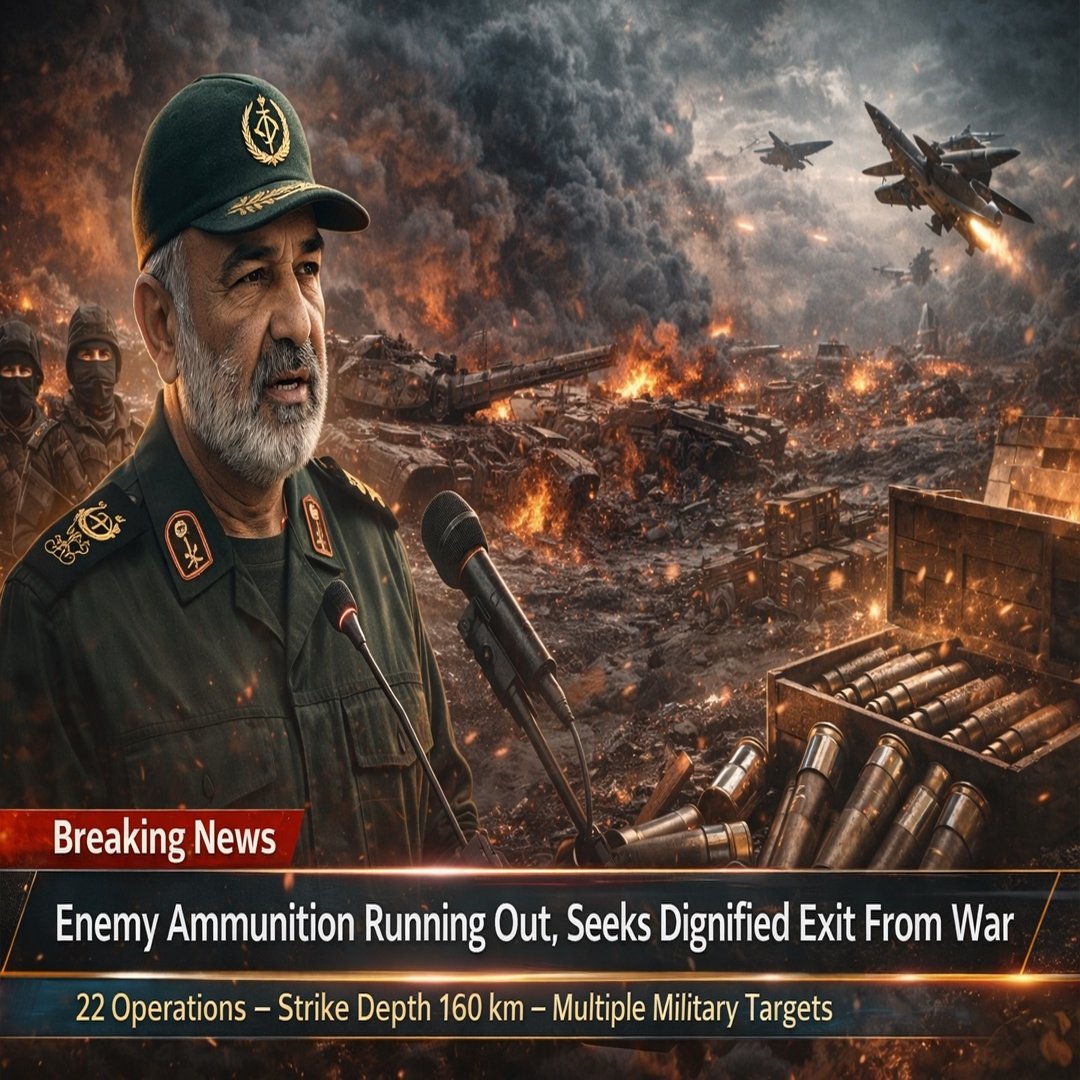
A new statement from the Islamic Revolutionary Guard Corps has intensified the war of words surrounding the ongoing conflict in the Middle East.
In a message released through Iranian military channels, the Revolutionary Guard declared that its adversaries are beginning to face a critical shortage of military resources.
“The enemy’s ammunition has begun to run out, and it is seeking a dignified exit from the war,” the statement said.
The remark appears to be directed primarily at the United States and its regional partners, who have been involved in a series of escalating military exchanges with Iran in recent weeks.
A Message of Confidence From Tehran
Iranian commanders framed the statement as evidence that the balance of the conflict is shifting.
According to the Revolutionary Guard, continued missile launches and drone operations have placed sustained pressure on opposing forces across the region.
Iranian officials argue that their strategy relies on endurance and asymmetric warfare — a military doctrine designed to confront technologically superior opponents through persistence, dispersed forces, and long-range strike capabilities.
The statement suggested that this approach is beginning to show results.
“The Enemy Cannot Continue Forever”
Military spokesmen linked to the Revolutionary Guard claimed that prolonged operations are exhausting the supply of precision munitions used by opposing forces.
Although Iran did not provide evidence for the claim, analysts note that prolonged conflicts often strain stockpiles of advanced weapons such as cruise missiles and air-defense interceptors.
Some strategic observers have warned that extended campaigns could place pressure on certain military inventories, especially if large numbers of missiles or interceptors are used in a short period of time.
Iran’s statement appears designed to highlight that possibility.
Psychological Warfare as Much as Military Strategy
Experts say the message from Tehran also serves a broader strategic purpose.
Public statements during wartime often function as psychological warfare, aimed at shaping public perception and influencing political decision-making.
By suggesting that opposing forces are running out of ammunition, Iran may be attempting to project confidence and portray itself as resilient despite ongoing military pressure.
Similar rhetoric has appeared in previous conflicts, where both sides attempt to demonstrate strength while questioning the endurance of their opponents.
Iran Signals It Will Continue Fighting
Alongside the claim about ammunition shortages, Iranian officials emphasized that they do not intend to stop their military campaign.
Previous statements from the Revolutionary Guard have suggested that Iranian forces will continue operations until what they describe as the “threat of war against Iran” is removed or their adversaries withdraw from confrontation.
This stance indicates that Tehran sees the conflict as far from over.
A War of Narratives
For now, the battlefield is not only defined by missiles and military deployments but also by competing narratives.
Washington and its allies insist their operations are weakening Iranian capabilities.
Tehran, meanwhile, claims the opposite — arguing that its strategy is gradually wearing down its opponents.
With both sides presenting conflicting assessments of the situation, independent verification remains difficult.
But one thing is certain:
As long as both sides believe they still have strategic advantages, the conflict — and the messaging surrounding it — is likely to continue.