

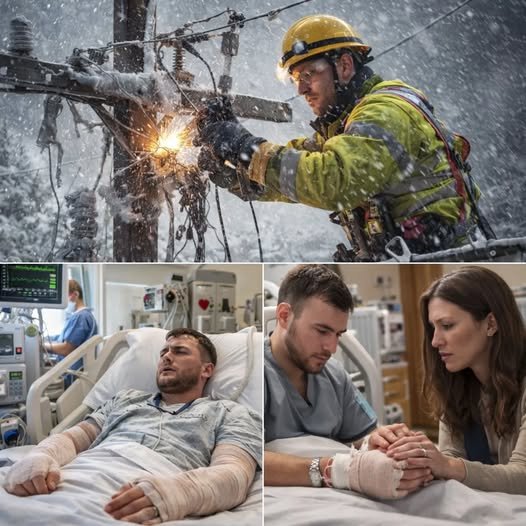
He went out in the worst conditions imaginable so others could have light, heat, and safety.
And it nearly cost him everything.
Hunter Alexander, a 24-year-old lineman, was doing what utility workers do without hesitation:
stepping into danger when entire communities depend on them most.
After a brutal ice storm left families in the dark, Hunter was out restoring power, working through conditions most people would never dare enter.
Then, in a single instant, everything changed.
A powerful electrical shock tore through his body, leaving catastrophic injuries to his arms and hands.
Within minutes, Hunter was rushed into critical care, where doctors began a desperate effort to
save not only his life, but the limbs that made his work — and his independence — possible.
Now, the man who went out to help others is the one in need of saving.

And the battle is no longer symbolic.
It is physical.
It is surgical.
It is life-altering.
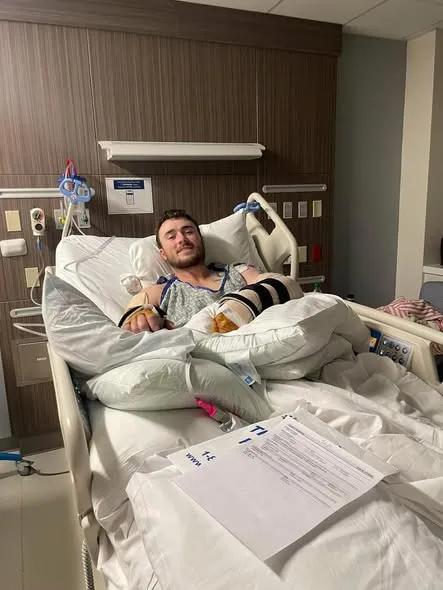
Hunter is now fighting to keep his arms.
Doctors have already performed multiple emergency procedures in an effort to stop the
damage from spreading and preserve as much healthy tissue as possible.

Among the most serious were fasciotomies — emergency surgeries used when swelling becomes
so severe that it begins cutting off circulation inside the limbs.
These are not minor procedures.
They are the kind of surgeries performed when the risk is no longer theoretical, when the body is on the edge of permanent damage and tissue loss.
In Hunter’s case, doctors had to perform them on both arms — a stark sign of just how severe the trauma truly was.
Since then, the hospital has become a battlefield of constant intervention.

Surgeons have removed damaged tissue to prevent further deterioration.
Wound vac systems have been placed to manage open wounds, reduce swelling, and support healing.
And through every stage of this process, doctors have remained brutally honest with the family:
The coming days are critical.
Not weeks.
Not months.
Days.

Because with injuries like Hunter’s, there is always the terrifying possibility that damaged tissue may not survive.
And if it doesn’t, doctors can be forced into the decision no family ever wants to hear:
Amputation.
That word now hangs over everything.
Every hour.
Every update.
Every procedure.
As Hunter prepares for yet another surgery, his loved ones are holding their breath and praying

for the outcome that feels like a miracle — that circulation remains strong, that viable tissue can still be saved,
and that doctors will not be forced to take more than they already have.
They are praying that this next surgery brings progress instead of devastation.
But beyond the medical details, there is another story unfolding inside that ICU room.
Hunter is not fighting alone.
His wife, Katie, has barely left his side. While he battles through unimaginable pain, surgeries, and uncertainty,

she has been there — sleeping nearby, waiting through long nights, refusing to let him face this nightmare without her.
That kind of devotion may never make headlines.
But it is the kind of strength that carries families through the unbearable silence between updates.
And according to those closest to them, every prayer,
every message, and every word of support has been felt.
Because when someone is in critical condition, love becomes more than comfort.

It becomes fuel.
This is the part people don’t always see.
When storms knock out power, most people think about inconvenience — dark homes, cold rooms, silent streets.
But few think about the men and women who walk directly into danger so the rest of us do not have to.
Hunter did.
And now he is paying the price.

This is what a hero without a cape looks like.
Not someone asking for attention.
Not someone chasing applause.
But a young man who stepped up when his community needed him most.
Now, his family is living inside a nightmare — holding onto hope, holding onto faith,