

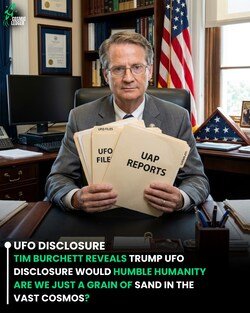
For years, the debate over UFOs has centered on a simple question: Are governments hiding evidence that could fundamentally change humanity’s understanding of reality?
Now, one of Congress’s most outspoken advocates for greater transparency on the UFO issue has made a statement that is capturing attention across the world.
According to U.S. Congressman Tim Burchett, if former President Donald Trump were to release the classified UFO photos and videos that he claims to have seen, the result would not necessarily be panic or fear. Instead, Burchett believes the revelations could leave humanity with a profound sense of humility about its place in the cosmos.
His message was simple yet powerful.
“We are one grain of sand on a hundred million beaches.”
The metaphor paints a picture of a universe so vast and incomprehensible that Earth itself becomes almost insignificant in comparison. For generations, astronomers have reminded humanity that our planet is just one world orbiting one star among hundreds of billions of stars in the Milky Way alone. Beyond that lie countless galaxies stretching across unimaginable distances.
Burchett’s comments suggest that the classified material allegedly held by the government may reinforce that perspective in dramatic fashion.
Supporters of UFO disclosure argue that the public has been shielded from information concerning unidentified aerial phenomena for decades. They point to military encounters, pilot testimonies, radar data, and congressional hearings as evidence that unexplained incidents deserve greater scrutiny.
In recent years, interest in the topic has grown substantially. Congressional investigations, whistleblower allegations, and declassified military footage have transformed what was once considered a fringe subject into a topic of serious public discussion.
Burchett has been among the lawmakers pushing for additional transparency, frequently questioning why so much information remains classified. While he has not publicly described the contents of any alleged classified imagery in detail, his recent remarks have fueled speculation that some materials could reveal technologies or phenomena beyond current public understanding.
If such evidence were ever released, the implications could be enormous.
Scientists would undoubtedly demand rigorous analysis and verification. Governments around the world would face pressure to explain what they know. Religious leaders, philosophers, and historians would debate what the discoveries mean for humanity’s place in existence.
Yet Burchett’s focus appears to be less about fear and more about perspective.
Rather than viewing humanity as the center of creation, he suggests that future revelations—if they occur—could remind us that we occupy only a tiny corner of a universe that may be far more complex than previously imagined.
Skeptics, however, continue to urge caution. They note that extraordinary claims require extraordinary evidence and that many UFO reports eventually receive conventional explanations. To date, no publicly released evidence has conclusively demonstrated the existence of extraterrestrial civilizations or non-human technology.
Even so, momentum surrounding disclosure efforts continues to build.
Former intelligence officials, military personnel, and members of Congress have increasingly called for greater openness regarding unidentified aerial phenomena. Public interest remains high, and each new hearing, report, or statement adds to the growing debate.
Whether future disclosures ultimately reveal misunderstood technologies, previously unknown natural phenomena, or something far more extraordinary remains unknown.
But if Tim Burchett’s comments are any indication, some officials believe the greatest impact would not be fear.
It would be humility.
The realization that humanity may not be the center of the story—and that the universe is far larger, stranger, and more mysterious than we ever imagined.