

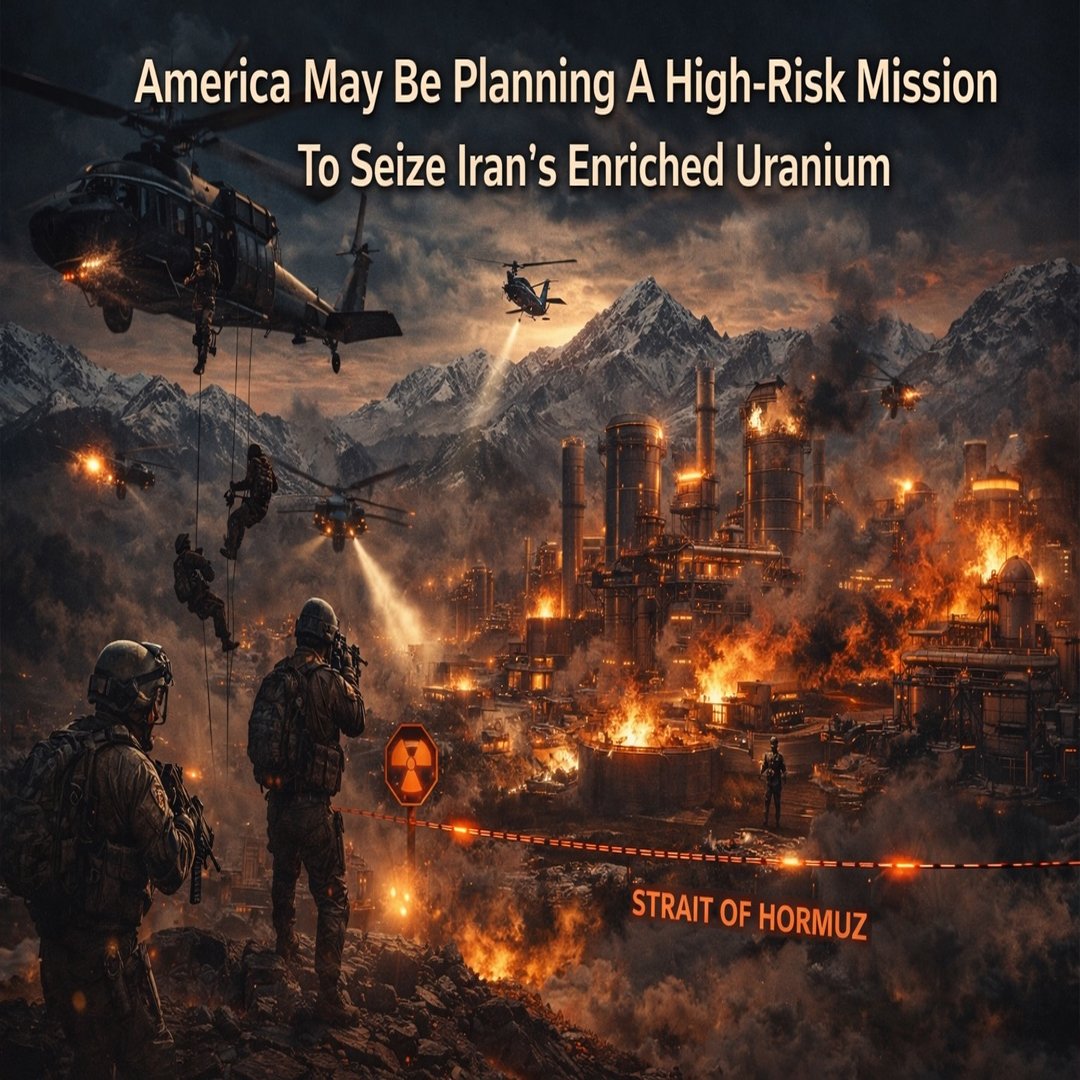
In recent days, international security analysts have been debating a scenario that, until recently, sounded almost unthinkable: a direct operation aimed at securing Iran’s stockpile of highly enriched uranium.
According to reports circulating in Washington policy circles and mentioned in discussions by commentators on CNN, the possibility of such a mission has quietly entered strategic conversations as tensions in the region continue to rise.
The discussion intensified after statements linked to former U.S. president Donald Trump, suggesting that ending the conflict immediately may not be his preferred course if conditions continue to deteriorate.
While no official operation has been confirmed, the mere suggestion of a mission targeting Iran’s nuclear material has sparked intense debate among military planners, intelligence analysts, and global security experts.
Why Iran’s Enriched Uranium Is Considered a Critical Target
At the center of the discussion lies one of the most sensitive strategic assets in the Middle East: Iran’s stockpile of enriched uranium.
The country’s nuclear program—overseen by institutions linked to the government of Ali Khamenei—has long been monitored by international observers and agencies such as the International Atomic Energy Agency.
Highly enriched uranium can be used in civilian nuclear energy programs, but it also has the potential to be refined further for weapons-grade purposes. Because of that dual-use nature, it has remained a central issue in negotiations and tensions between Tehran and Washington.
Several nuclear facilities have drawn particular international attention, including the heavily fortified Fordow Fuel Enrichment Plant and the large uranium enrichment complex at Natanz Nuclear Facility.
Both locations are considered among the most heavily defended strategic sites in Iran.
The Military Scenario Being Discussed
Military analysts say that if such an operation were ever considered, it would likely involve elite units from United States Special Operations Command.
The hypothetical mission might involve:
• Long-range stealth aircraft transporting special forces
• Rapid airborne or helicopter insertion near a nuclear site
• Securing and removing enriched uranium stockpiles
• Immediate extraction before Iranian forces could respond
On paper, the U.S. military possesses the capabilities required for such a complex mission. Decades of training, advanced logistics, and global strike assets have prepared American forces for highly specialized operations in difficult environments.
But experts emphasize that capability does not mean feasibility.
Why Experts Call It “Extremely Dangerous”
Despite the technological advantage of U.S. forces, analysts widely agree that a mission inside Iran would be one of the most dangerous military operations imaginable.
Iran maintains extensive air-defense systems and a large network of military forces across the country. Strategic facilities are often located underground or protected by reinforced infrastructure designed specifically to survive airstrikes.
Even if American special forces were able to land near a nuclear site, several critical challenges would immediately arise.
First, the uranium stockpiles themselves are difficult to transport quickly. Removing nuclear material safely requires specialized containment equipment and time—both of which would be extremely limited during a covert raid.
Second, Iranian military units could respond rapidly. Iran’s Islamic Revolutionary Guard Corps maintains forces capable of mobilizing quickly around sensitive installations.
And finally, the biggest risk: extraction.
Experts say that landing inside Iran might be possible. Leaving safely could be far more difficult.
The Risk of Escalation
If such an operation were attempted—and especially if it failed—it could trigger a massive escalation in regional conflict.
Iran could interpret the action as a direct act of war, potentially responding with missile strikes or military retaliation across the Middle East.
Neighboring countries hosting U.S. military bases could become immediate targets, and international shipping lanes in the region could face disruptions.
The political consequences would also be enormous, potentially drawing other global powers into the crisis.
Why the Idea Is Even Being Discussed
So why would such a risky operation even be considered?
Strategic planners argue that enriched uranium represents a uniquely valuable target.
Destroying nuclear facilities from the air can slow a nuclear program—but seizing or neutralizing the material itself could potentially halt progress for years.
For that reason, some analysts believe decision-makers might consider extraordinary options if they believed a nuclear breakthrough was imminent.
Still, most experts stress that such an operation would only be considered under the most extreme circumstances.
A Hypothetical Scenario—for Now
At this stage, officials have not confirmed any active plan to launch such a mission.
Defense analysts emphasize that many strategic options are often studied inside military planning circles without ever being executed.
For now, discussions surrounding a potential operation to seize Iran’s enriched uranium remain hypothetical.
But the debate itself reflects how tense the geopolitical environment has become—and how high the stakes are in the ongoing struggle over nuclear technology in the Middle East.
Whether the idea remains a theoretical exercise or evolves into something more serious will likely depend on political decisions, intelligence assessments, and the rapidly shifting dynamics of global security.
For now, the world is watching carefully.