

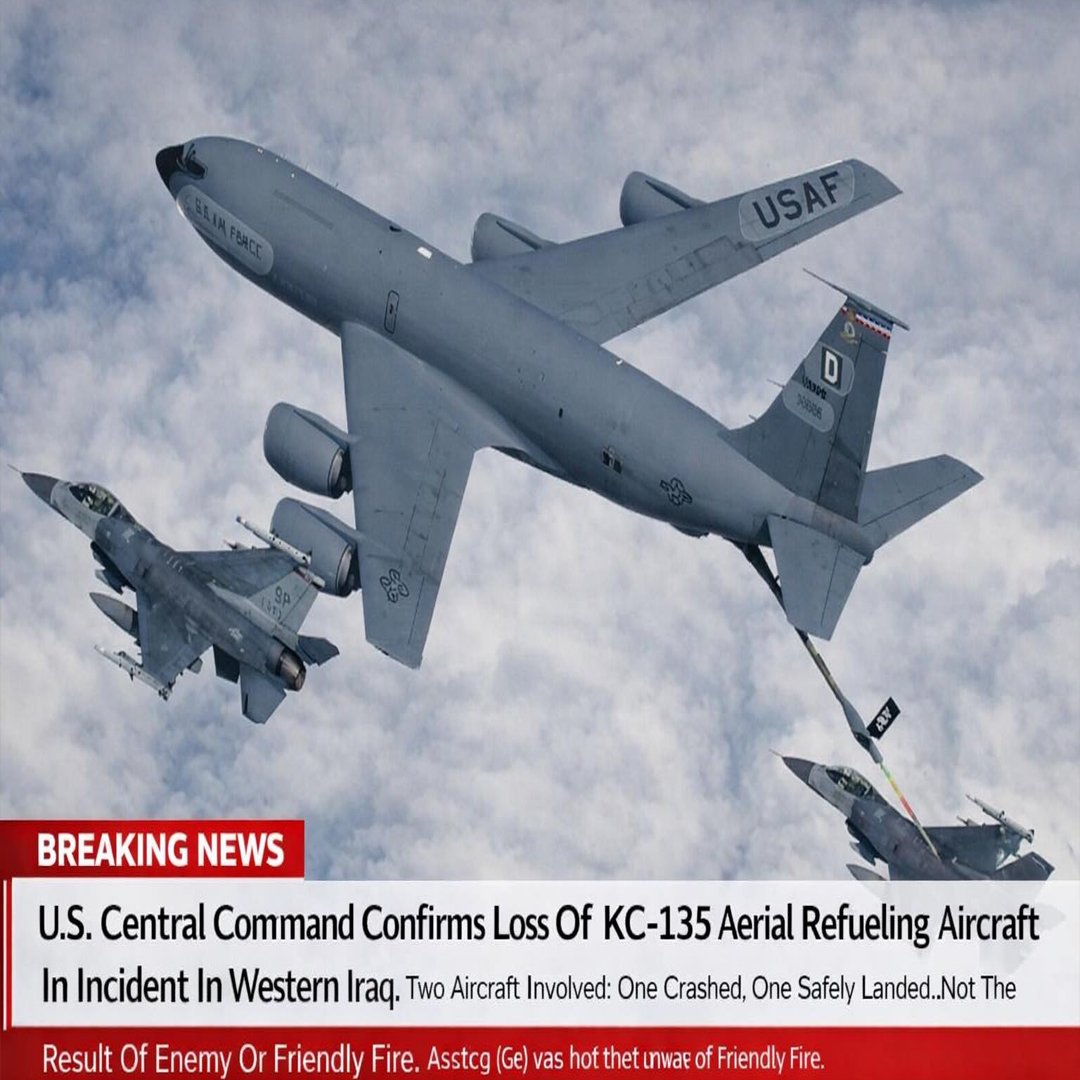
A tense atmosphere spread through military channels late last night after United States Central Command confirmed the loss of a Boeing KC-135 Stratotanker aerial refueling aircraft during an operational mission over western Iraq.
According to preliminary statements released by military officials, two aircraft were involved in the incident while conducting routine flight operations in the region. One aircraft ultimately crashed in a remote desert area, while the second aircraft managed to stabilize and return safely to base after declaring an emergency.
The unexpected incident has triggered an immediate search-and-rescue operation across a wide stretch of desert terrain, with military teams racing against time to locate any survivors and recover critical flight data.
A Mission That Took a Sudden Turn
The aircraft were reportedly operating under the command of United States Air Force as part of a broader logistical mission supporting regional operations in the Middle East. The KC-135 Stratotanker plays a critical role in military aviation, allowing fighter jets, surveillance aircraft, and transport planes to refuel mid-air and extend their operational range.
Sources familiar with the mission described the flight as routine before the situation rapidly changed.
Pilots flying nearby reportedly noticed irregular flight patterns shortly before contact was lost with the aircraft that later crashed.
Within minutes, emergency alerts were issued across command networks monitored by United States Department of Defense.
Air traffic controllers attempted to re-establish communication while the second aircraft initiated emergency procedures and diverted to a nearby military facility.
One Aircraft Lost, Another Lands Safely
Officials confirmed that two KC-135 aircraft were operating in proximity during the mission when the incident occurred.
While one aircraft suffered a catastrophic failure and went down in western Iraq, the second tanker aircraft was able to remain airborne and land safely after reporting technical complications.
Military officials have not yet revealed whether the aircraft made physical contact or if another mechanical or environmental factor contributed to the crash.
However, early reports indicate that no hostile activity was detected in the area at the time of the incident.
Not Caused by Enemy or Friendly Fire
One of the most significant early confirmations from investigators is that the crash was not the result of enemy fire or friendly fire.
Officials emphasized that radar monitoring and intelligence systems in the region detected no missile launches, weapons fire, or hostile aircraft activity during the timeframe of the accident.
That confirmation has shifted the focus of investigators toward possible mechanical malfunction, navigational failure, or rare mid-air operational complications.
Military aviation experts note that incidents involving tanker aircraft are extremely rare, given the rigorous maintenance standards and strict flight protocols used by the U.S. Air Force.
Massive Search and Rescue Operation Underway
Immediately after the aircraft disappeared from radar, search and rescue units were deployed across western Iraq.
Helicopters, surveillance drones, and ground recovery teams began scanning the desert landscape overnight, navigating difficult terrain and limited visibility.
The region where the aircraft is believed to have crashed is known for its vast, isolated desert stretches, where temperatures fluctuate dramatically between day and night.
Recovery teams are working alongside coalition forces already stationed in the region to secure the crash site and search for possible survivors.
Officials say the priority remains locating the crew and securing the wreckage before investigators begin a full accident reconstruction.
Investigators Begin Piecing Together the Timeline
Accident investigators from both the U.S. Air Force and the Department of Defense are preparing to analyze several critical sources of information.
These include:
- Flight data recorders
- Cockpit voice recordings
- Radar tracking data
- Communications logs between pilots and air traffic control
Investigators will also interview the crew of the second aircraft that landed safely, whose testimony may help reconstruct the final moments before the crash.
Military aviation analysts say those pilots could provide the most important eyewitness account of the incident.
Strategic Importance of the KC-135 Fleet
The KC-135 Stratotanker has been a cornerstone of American air power for decades.
First introduced in the late 1950s, the aircraft continues to serve as a critical support platform for long-range air operations. By refueling aircraft mid-air, KC-135 tankers allow fighter jets and bombers to remain in the sky for extended missions that would otherwise be impossible.
Thousands of these missions occur every year across multiple global theaters.
Despite their long service history, the aircraft remain highly reliable due to constant upgrades, inspections, and modernization programs.
That reliability is one reason this incident has drawn immediate attention across defense circles.
Military Community Awaits Answers
As news of the crash spreads through military communities and among defense analysts, many questions remain unanswered.
What exactly caused the aircraft to go down?
Did mechanical failure play a role?
Or did something unexpected occur during the aerial refueling operation itself?
For now, officials are urging patience as investigators begin the complex process of determining the cause.
“This is an active investigation,” one defense official said. “Our focus right now is supporting the recovery operation and understanding exactly what happened.”
A Developing Story
For families, fellow service members, and the broader military community, the hours ahead will be filled with uncertainty.
Search teams continue to comb the crash zone in western Iraq, hoping for answers and clarity.
Meanwhile, officials promise that a full and transparent investigation will follow once the wreckage and flight data have been recovered.
Until then, the loss of the KC-135 serves as a sobering reminder of the risks faced every day by military aviators operating across some of the world’s most challenging environments.
More updates are expected as the situation develops.