

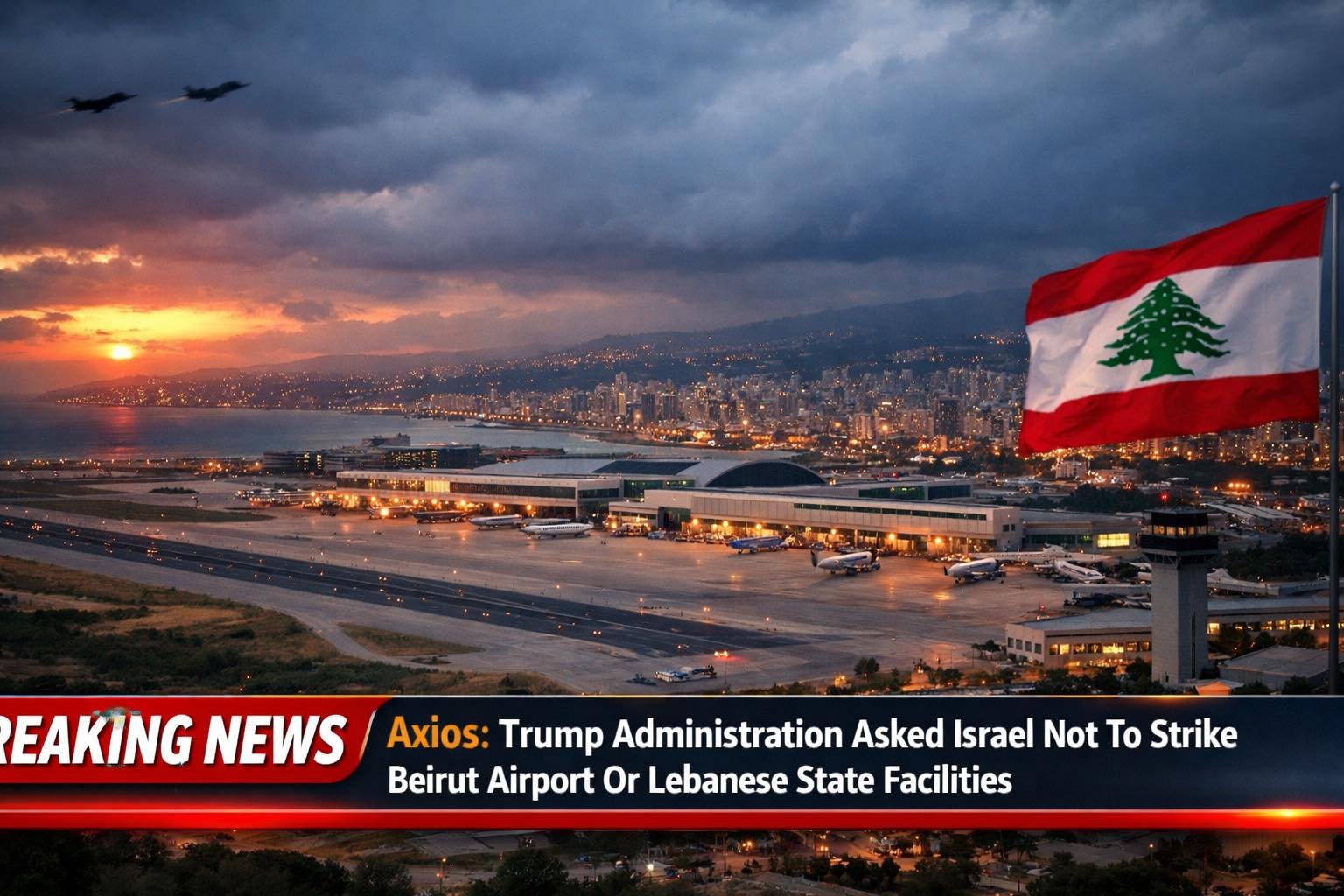
A new report has sent fresh tremors through an already volatile Middle East, as Axios revealed that the Trump administration reportedly asked Israel not to strike Beirut’s international airport or other Lebanese state facilities, even while fears of a broader regional war continue to intensify. The reported request, if fully understood in context, offers a rare glimpse into the delicate balancing act now unfolding behind closed doors: strong support for Israel on one side, and urgent concern over a catastrophic escalation on the other.
At a moment when military tensions are rising, civilians are fleeing, and diplomacy seems to be fighting for survival, the significance of that message cannot be overstated. In public, the United States has remained aligned with Israel’s broader security objectives. But in private, according to the report, Washington appears to be drawing at least some red lines — not necessarily against military action itself, but against steps that could collapse what remains of Lebanon’s fragile state structure and push the region into an even more uncontrollable phase of conflict.
The report comes as Israel is said to be preparing for the possibility of a major ground operation in southern Lebanon, one that could become its largest campaign there in many years. Officials cited by Axios indicated that the objective would be to seize territory south of the Litani River and dismantle Hezbollah’s military infrastructure, an operation that would dramatically deepen the conflict and almost certainly trigger severe humanitarian, political, and diplomatic consequences.
In that context, the reported U.S. request regarding Beirut airport and Lebanese government facilities takes on enormous meaning.
Those are not just buildings. They are symbols of state continuity, civilian access, international diplomacy, and national survival. Beirut’s airport, in particular, is more than a transportation hub. In times of war and uncertainty, it becomes a lifeline — for civilians trying to escape, for aid and diplomacy, for families separated by violence, and for a country struggling to remain connected to the outside world. A strike on such infrastructure would not simply be military escalation. It would send a message that the line between targeting an armed group and crippling an entire nation’s state capacity had all but disappeared.
That is likely why the reported request matters so much. It suggests the Trump administration may believe that while Hezbollah can be targeted militarily, the destruction of core Lebanese state infrastructure could create a strategic disaster — one that would deepen chaos, undermine any diplomatic off-ramp, and fuel broader regional fallout. That inference is supported by the wider diplomatic context, though U.S. officials have not publicly framed it in exactly those words.
The timing is especially striking because the broader Lebanon file appears deeply unstable and rapidly changing. Reuters reported on March 14, 2026 that Israel and Lebanon were expected to hold direct talks in the coming days, according to Haaretz, in what would have been a remarkable diplomatic development amid the fighting. But by March 15, 2026, Reuters also reported that Israeli Foreign Minister Gideon Saar publicly denied reports that such talks were planned. That contradiction captures the atmosphere surrounding the crisis perfectly: diplomacy is being floated, denied, reshaped, and clouded almost in real time.
At the same time, other reporting points to a broader international effort to prevent the Lebanon front from spiraling beyond repair. Axios reported that France has proposed a plan aimed at ending the war in Lebanon, increasing pressure to disarm Hezbollah, and opening a path toward a political declaration between Lebanon and Israel. Reuters has also reported that Lebanese President Joseph Aoun had shown willingness to pursue direct talks with Israel, though those overtures were met with skepticism and did not immediately produce a breakthrough.
All of this means the message reportedly delivered by Washington was not just about one airport or one set of state buildings. It was about preserving some minimum structure from which diplomacy could still function.
And that is where the story becomes larger than a single scoop.
For years, every major confrontation involving Hezbollah and Israel has raised the same underlying question: can military pressure remain focused on the armed group itself, or will Lebanon as a whole once again pay the price? The answer has never been easy. Hezbollah is deeply embedded in Lebanese political and social realities, yet Lebanon’s official state institutions are distinct from Hezbollah and often too weak to control it. That creates a brutal dilemma. Strikes meant to pressure Hezbollah can weaken the very state institutions that any future settlement would require. Too much restraint, on the other hand, is seen by Israel as allowing Hezbollah to survive and rebuild.
This is why the reported U.S. request carries both strategic and moral weight. It implies recognition that there is a difference between expanding a war and shattering a country.
The concern is not theoretical. Lebanon is already under enormous pressure from displacement, airstrikes, internal political strain, and the broader regional war environment. Reuters reported on March 14 that hundreds of people had been killed and hundreds of thousands displaced amid the intensified conflict. In such a fragile environment, attacks on state infrastructure could accelerate state collapse, unleash new waves of panic, and make a negotiated outcome even harder to imagine.
What makes the situation even more combustible is the wider regional backdrop. The conflict involving Iran, Israel, and the United States has magnified every front in the region, including Lebanon. As tensions spread across multiple theaters, even a single major strike in Beirut could become more than a tactical event. It could become a political and symbolic trigger, drawing in new actors, inflaming public opinion, and pushing already shaky diplomacy off a cliff.
For Israel, the logic of force is likely tied to deterrence and the stated goal of removing Hezbollah’s military threat near its border. For Washington, however, the challenge appears more layered. Supporting Israel while also trying to prevent a full state-level collapse in Lebanon is not a contradiction so much as a recognition of consequences. If Beirut airport is destroyed, if ministries and state facilities are hit, if Lebanon’s official institutions are humiliated or broken beyond repair, the aftermath may not produce stability — it may produce a vacuum. And vacuums in the Middle East have a habit of becoming far more dangerous than the conditions that preceded them.
There is also the optics problem. In modern conflict, infrastructure carries narrative power. A strike on a military warehouse can be explained as a battlefield action. A strike on an international airport or key civilian-linked state sites resonates differently around the world. It can reshape headlines, alter diplomatic support, and intensify accusations that the war has crossed from combat into collective punishment. Even governments that privately understand Israeli security arguments can find themselves under enormous public pressure if civilian state infrastructure becomes the image of the war.
That may be part of why this reported request surfaced now. Whether it was framed as advice, caution, or pressure, it signals that Washington understands that some targets would carry consequences far beyond the battlefield.
Still, the uncertainty remains huge.
Israel has not publicly committed to the boundaries described in the report. The broader military campaign appears to be intensifying, not slowing. Reuters reported that Israel had even warned it may strike ambulances and medical facilities it says are used by Hezbollah, while diplomatic reports around direct talks have become muddled and contradictory within a single news cycle. That is not the atmosphere of a stable de-escalation. It is the atmosphere of a region teetering between war management and war expansion.
And so the real significance of the Axios report may not lie only in what was asked, but in what it reveals: that behind the scenes, key actors appear to understand just how close this crisis may be to crossing another threshold.
If true, the reported U.S. message was a warning wrapped inside an alliance — a signal that some lines, once crossed, could be impossible to walk back. In a conflict where every day seems to bring new threats, denials, troop movements, and diplomatic confusion, that kind of message may be one of the few remaining efforts to hold back a much larger disaster.
For now, the world is left watching the same dangerous question unfold over Beirut, southern Lebanon, and the broader region:
Will the next phase of this war be shaped by restraint, or by the belief that there is no room left for it?
That answer may determine not only the fate of Lebanon’s infrastructure, but the fate of whatever fragile path to de-escalation still exists.