

For centuries, historians and theologians have debated whether the earliest followers of Jesus regarded him merely as a teacher and prophet or as truly divine.
While written sources such as the New Testament have long affirmed belief in his divinity, critics have often argued that this understanding developed gradually and was shaped by later councils and imperial influence.
In recent decades, however, archaeology has begun to provide unexpected and tangible evidence that challenges this assumption.
One of the most striking discoveries comes from northern Israel, where an ancient mosaic inscription offers rare insight into how Jesus was understood and worshiped nearly two thousand years ago.
The story of this discovery began in 2005 during what was expected to be a routine archaeological excavation.
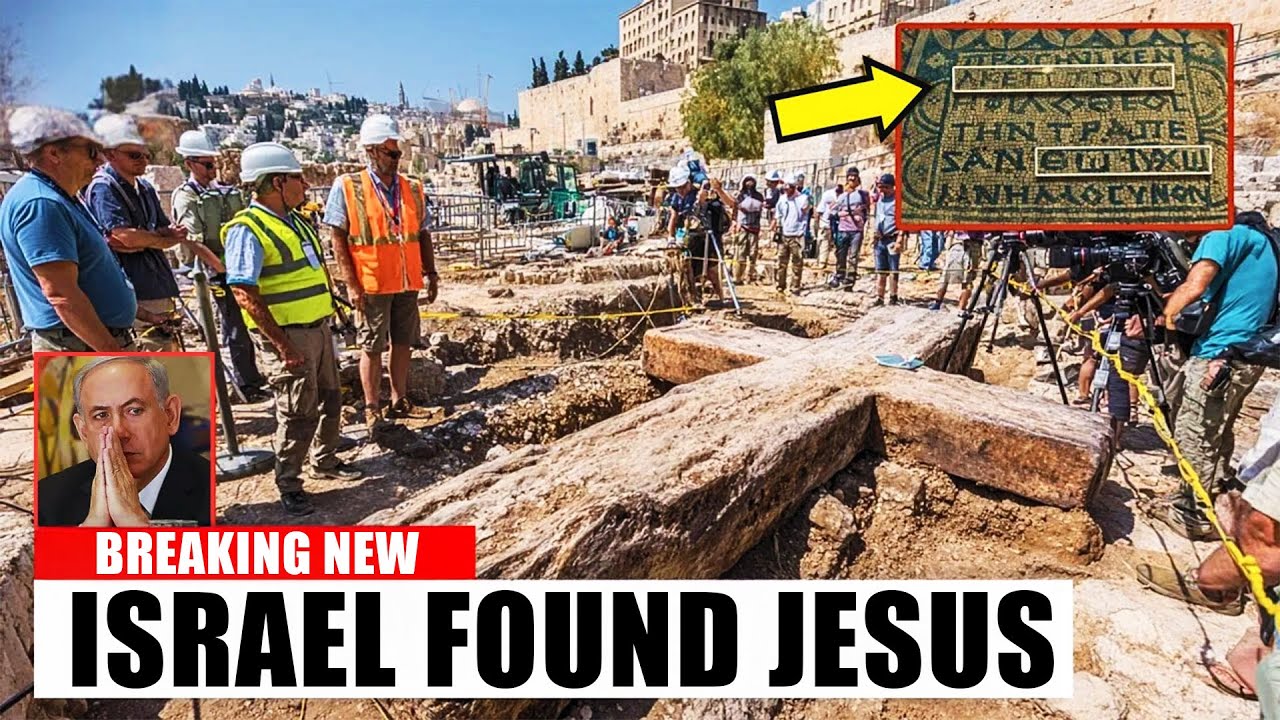
The site was located beneath a modern prison complex in northern Israel, an area not initially associated with major religious findings.
As part of renovation and restoration work, archaeologists were granted access to the ground beneath the structure.
During the process, workers uncovered fragments of a richly decorated mosaic floor that had been hidden for centuries under layers of stone, earth, and modern construction.
At first glance, the mosaic appeared to be a typical example of Roman era decorative art.
It featured geometric patterns, floral motifs, and carefully arranged stone tiles.
However, as the excavation continued, faint Greek inscriptions embedded within the mosaic began to emerge.
These inscriptions were remarkably well preserved, protected by the very structures that had concealed them for so long.
Once cleaned and documented, the words revealed something extraordinary.
The inscriptions made direct reference to Jesus Christ, identifying him explicitly as God.
This was not a poetic metaphor or a vague devotional phrase.
The language was clear, intentional, and unmistakable.
Scholars studying the text concluded that the mosaic once formed part of an early Christian prayer hall, possibly one of the earliest known in the region of ancient Israel.
Based on stylistic analysis, linguistic features, and historical context, experts dated the mosaic to approximately the late second or early third century, around 180 to 230 AD.
This dating places the inscription less than two centuries after the crucifixion of Jesus.
At that time, Christianity had not yet become a legally recognized religion within the Roman Empire.
There were no ecumenical councils defining doctrine, no imperial backing, and no standardized theological system.
Christian communities were small, often marginalized, and in some regions faced social pressure or hostility.
Yet, within this context, a group of believers chose to inscribe their faith permanently into stone.
One particular inscription has drawn significant attention from scholars.

It records the dedication of an offering table, stating that a woman described as a lover of God named Akeptous offered the table to God Jesus Christ as a memorial.
Historians believe that this woman was likely a person of means and influence within her local community.
Her decision to sponsor and dedicate an object for worship indicates both personal conviction and communal acceptance of the belief expressed in the inscription.
The significance of this dedication cannot be overstated.
It represents one of the earliest known physical artifacts in which Jesus is explicitly called God.
Unlike later theological texts written by church leaders, this inscription reflects the lived faith of ordinary believers.
It was not produced by an emperor, a council, or a powerful institution.
It was created by members of a local community who believed strongly enough in their understanding of Jesus to carve it into the floor of their place of worship.
What makes the discovery even more remarkable is its geographical context.
This mosaic was found in Israel itself, among a population deeply shaped by Jewish religious tradition.
Judaism, both in antiquity and today, does not recognize Jesus as divine.
Other Abrahamic traditions, such as Islam, honor Jesus as a prophet while denying his divinity.
Yet this mosaic demonstrates that within a relatively short period after his death, some people of Jewish background came to worship Jesus as God.
For archaeologists and historians, this challenges the notion that belief in the divinity of Jesus was a later development imported from Greek or Roman philosophical thought.
Instead, it suggests that such belief emerged very early, even within the cultural and religious environment from which Jesus himself came.
The mosaic stands as material evidence that devotion to Jesus as divine was not confined to distant provinces of the empire but existed in the very land where his life and ministry unfolded.
The discovery also contributes to a broader understanding of early Christian worship practices.
The presence of a dedicated prayer hall with a decorated mosaic floor indicates an organized community gathering for worship.
This suggests that early Christian life involved not only private belief but also communal rituals, offerings, and shared expressions of faith.
The inscription naming a donor further reflects the social structure of these communities, where individuals contributed resources to support worship and preserve memory.
After its discovery, the mosaic was carefully documented and removed using precise techniques to prevent damage.
The Israel Antiquities Authority oversaw the process, recognizing the importance of preserving the artifact for study and public display.
To facilitate conservation and allow wider access, the mosaic was transported to the United States, where it is currently exhibited at the Museum of the Bible in Washington DC.
There, visitors can view the ancient stonework and read the inscription that has captured global attention.
Israeli authorities have stated that this arrangement is temporary.
Plans are underway to complete restoration of the original site beneath the former prison complex.
Once finished, the location is expected to be transformed into a heritage and pilgrimage site.
The mosaic is anticipated to return to Israel, where it will be displayed in its cultural and historical context, allowing visitors from around the world to encounter this remarkable testimony firsthand.
For scholars of biblical studies, the mosaic offers more than visual beauty.
It provides external confirmation that aligns with early Christian writings.
The New Testament, particularly texts such as the Gospel of John and the letters of Paul, presents Jesus as divine from a very early stage of Christian belief.
Critics have sometimes argued that these texts were influenced by later theological developments.
However, the mosaic demonstrates that belief in Jesus as God was already present among ordinary believers before Christianity gained political power or formal doctrinal definitions.
It is also important to note that at the time the mosaic was created, there was no compiled Christian Bible as it exists today.
Sacred writings circulated in various forms, often as individual scrolls or letters.
Despite this, communities developed a shared understanding of Jesus that went beyond viewing him as a moral teacher.
The mosaic reflects a conviction formed through lived experience, communal worship, and transmitted tradition rather than institutional enforcement.
The emotional impact of this discovery extends beyond academic circles.
For many believers, it serves as a powerful reminder that faith in Jesus as divine is not a later invention, but a belief rooted in the earliest generations of his followers.
The inscription acts as a voice from the past, speaking across centuries with clarity and confidence.
It suggests that devotion to Jesus was strong enough to inspire lasting artistic and architectural expression even in uncertain times.
Archaeology continues to play a crucial role in illuminating the early history of Christianity.
While not every question can be answered by material evidence, discoveries like this mosaic enrich understanding and invite reconsideration of long held assumptions.
They demonstrate that faith left traces not only in texts but also in stone, tile, and communal spaces.
The mosaic in northern Israel stands as one of the clearest examples of this phenomenon.
It does not rely on interpretation of later manuscripts or theological arguments developed over centuries.
It presents a straightforward declaration crafted by early believers who understood Jesus as God and expressed that belief openly within their community.
As new discoveries continue to emerge from the soil of the Middle East, they remind both scholars and the public that history often holds surprises.
Each artifact adds another piece to the complex picture of early Christian life.
In the case of this mosaic, that picture includes a community willing to proclaim its faith in a way that would endure long after their voices had fallen silent.
Ultimately, the ancient mosaic is more than an archaeological find.
It is a tangible link to the spiritual convictions of the past.
It shows that belief in Jesus as divine was not merely debated in later centuries, but lived, practiced, and inscribed by some of his earliest followers.
Through careful excavation and preservation, this voice from history continues to speak, offering insight into the origins of one of the world’s most influential faiths and reminding modern readers that the stones themselves still have stories to tell.