

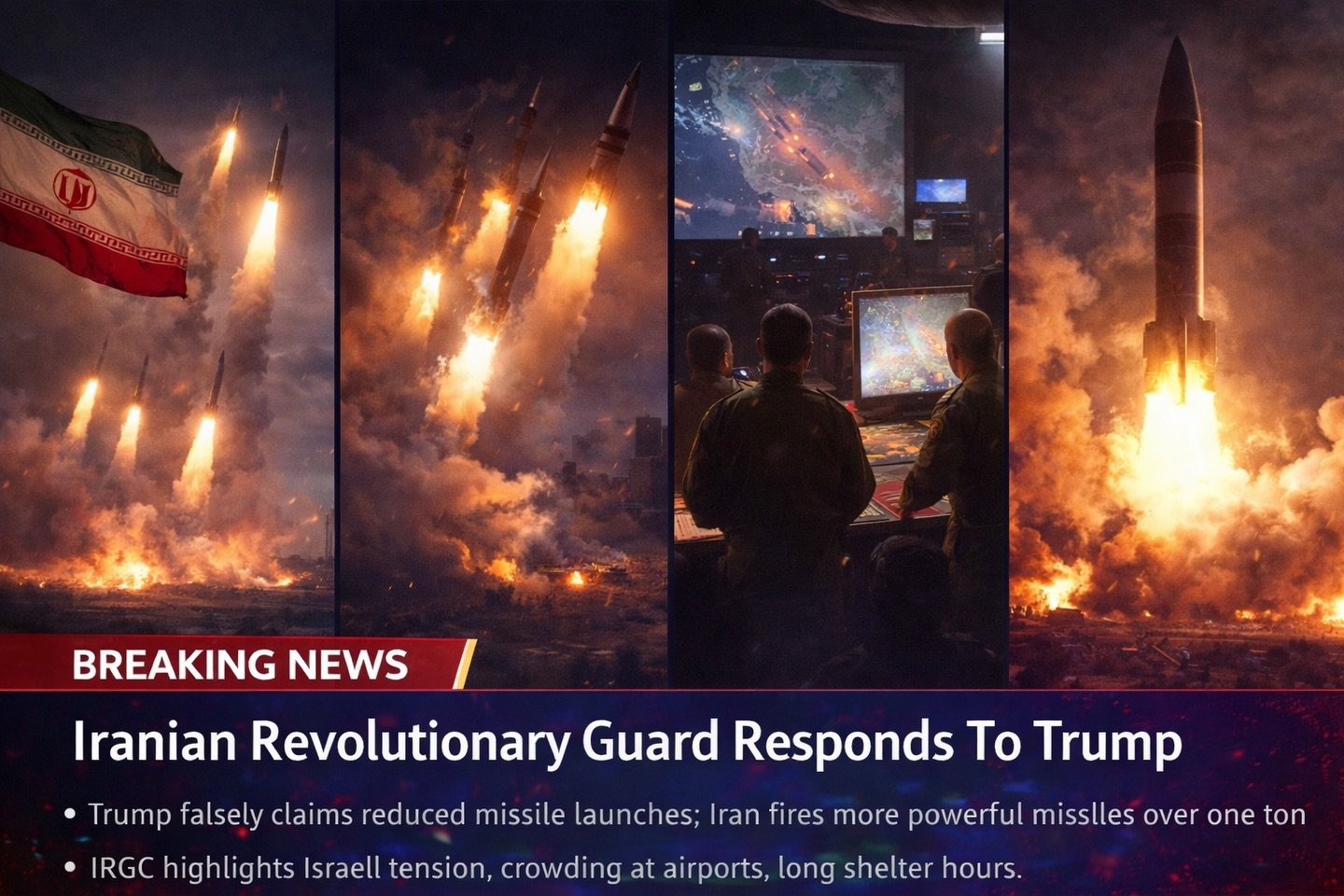
A dramatic new statement from Iran’s powerful military organization, the Islamic Revolutionary Guard Corps (IRGC), has intensified tensions across the globe as the war of words between Tehran and Washington continues to escalate.
In a televised announcement broadcast across Iranian state media late Monday evening, senior officials within the IRGC pushed back strongly against claims made by U.S. President Donald Trump that Iran’s missile campaign has been weakening.
According to Trump, recent U.S. strikes had significantly reduced Iran’s ability to launch missiles, with American officials claiming that the number of Iranian missile launches had dropped sharply in recent days. U.S. military sources also suggested that key production facilities had been destroyed, limiting Iran’s capability to replenish its arsenal.
But Iran’s Revolutionary Guard tells a very different story.
“We have not reduced our missile operations,” the statement read. “What has changed is the power and weight of the missiles we are now deploying.”
The IRGC claimed that rather than firing large numbers of smaller weapons, Iran has shifted to launching fewer but significantly more powerful ballistic missiles equipped with warheads weighing more than one ton.
According to Brigadier General Majid Mousavi, commander of the IRGC’s aerospace forces, Iran will no longer launch missiles carrying warheads lighter than one ton, signaling what he described as “a new phase of escalation” in the conflict.
A Strategic Shift in Warfare
Military analysts say the shift could represent a deliberate strategic move.
Instead of relying on overwhelming numbers of missiles to saturate air-defense systems, Iran may now be prioritizing heavier payloads capable of causing greater destruction with each strike.
A single one-ton warhead has the potential to level buildings, cripple military infrastructure, and create significant shockwaves across large urban areas.
Defense experts say the move could also be designed to challenge advanced missile defense systems such as Israel’s Iron Dome and American Patriot systems, which are optimized to intercept large numbers of incoming projectiles.
“If the number of launches decreases but the explosive yield increases dramatically, the battlefield math changes,” one regional security analyst explained. “Each missile becomes a strategic weapon rather than just another projectile.”
Trump’s Claims Under Fire
The IRGC statement appeared to directly target comments from President Trump, who earlier declared that Iran’s missile capability had been “crippled” following a series of U.S. airstrikes across Iranian territory.
Trump suggested that Iran’s military had lost the ability to sustain a prolonged missile campaign and predicted that the conflict could soon come to an end.
Tehran, however, rejected those claims outright.
Iranian officials accused Washington of misreading Iran’s military posture, warning that the country still possesses vast missile reserves and the capability to escalate the conflict further if necessary.
“Our enemies mistake patience for weakness,” the statement continued. “Iran’s armed forces remain fully prepared for any level of confrontation.”
Rising Regional Tensions
The war between Iran and U.S.-aligned forces has already expanded across several parts of the Middle East.
Missile and drone attacks have been reported in multiple countries in the Gulf region, while Israel has carried out strikes on Iranian military facilities and suspected missile infrastructure.
Officials across the region warn that the situation remains highly volatile, with oil routes, military bases, and major cities all considered potential targets.
Diplomatic efforts to de-escalate the crisis have so far produced little progress.
Meanwhile, global markets and security analysts are closely watching every statement coming from Tehran and Washington.
Because in a conflict where both sides claim strength — and neither appears willing to back down — words can be almost as powerful as missiles.
And right now, the world is listening.