

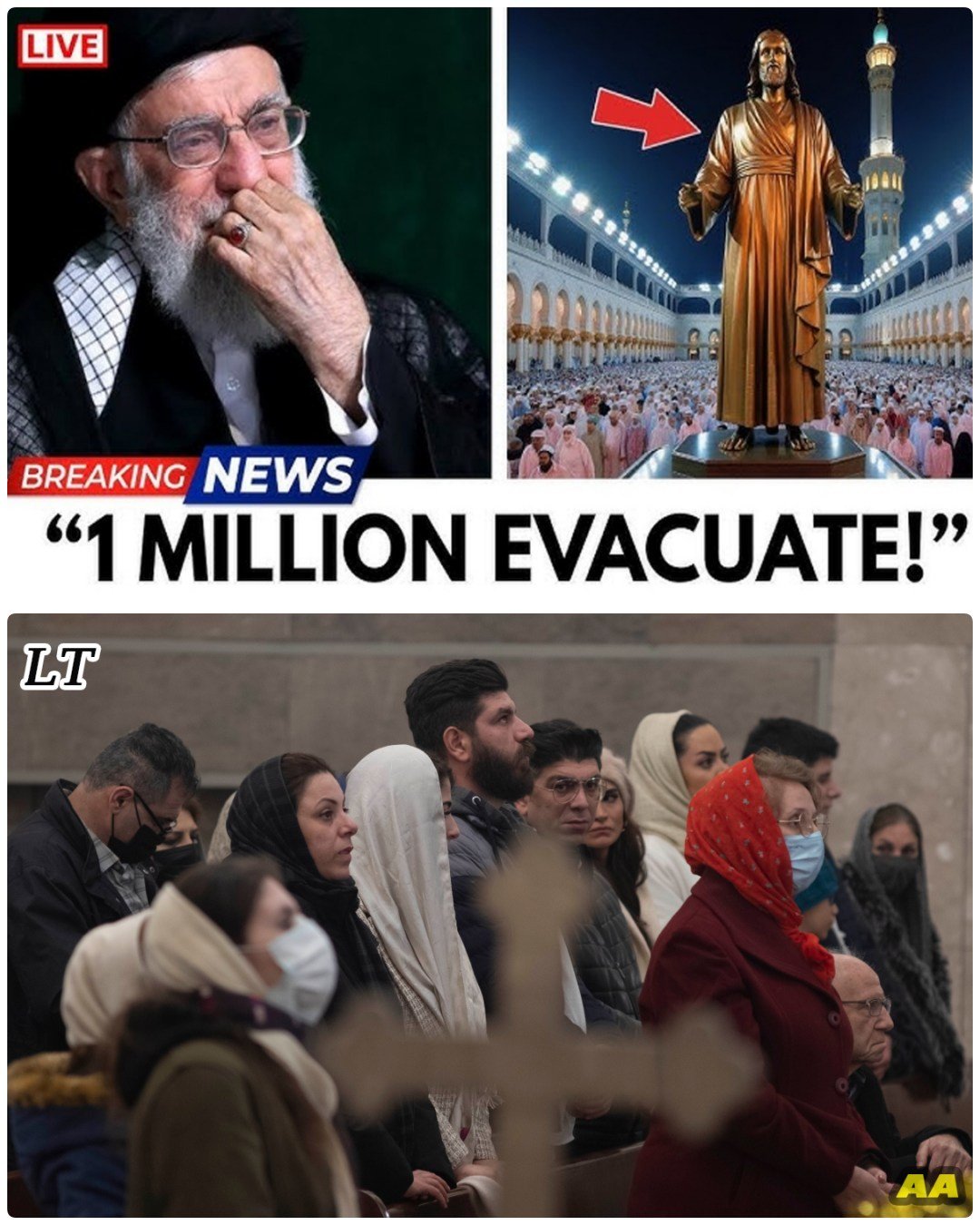
In a dimly lit apartment in northern Tehran, the curtains are drawn tight long before sunset.
The television is turned up just enough to muffle conversation.
Shoes are lined neatly by the door, ready to be slipped on at the first unexpected knock.

Around a small wooden table, seven people bow their heads over worn pages of a Persian New Testament.
Their voices are barely above a whisper, yet the intensity in the room feels electric.
For them, faith is not a public declaration.
It is a risk measured in heartbeats.
Scenes like this, once rare and isolated, are increasingly described by insiders, researchers, and members of the Iranian diaspora as part of a quiet but significant shift inside the Islamic Republic of Iran.
While the country’s constitution recognizes Christianity as a minority religion for certain historic communities such as Armenians and Assyrians, conversion from Islam remains highly sensitive and often dangerous.
Authorities have repeatedly warned against what they describe as illegal house churches and foreign-influenced evangelism.
Yet despite arrests, surveillance, and crackdowns, reports suggest that interest in Christianity may be growing beneath the surface.
Over the past decade, various survey-based studies conducted outside Iran, along with testimonies from church networks and advocacy organizations, have hinted at an unexpected trend.
Some researchers claim that a rising number of Iranians are identifying with Christian beliefs, though exact figures are impossible to verify due to the underground nature of the movement.
Government statistics do not reflect conversions, and participants inside the country rarely speak openly.
The true scale remains obscured by fear, secrecy, and political tension.
What fuels such a shift in one of the Middle East’s most tightly controlled religious environments? Analysts point to a complex mix of social, political, and generational factors.
Iran has a young, highly educated population with widespread internet access despite censorship efforts.
Satellite television channels, encrypted messaging apps, and social media platforms provide exposure to ideas beyond state-sanctioned narratives.
In that digital space, religious exploration can begin quietly, sometimes with nothing more than a question typed into a search bar late at night.
Former Muslims who have embraced Christianity often describe a deeply personal journey rather than a political rebellion.
Some speak of disillusionment with institutional religion.
Others recount spiritual experiences or encounters with Christian media broadcasts beamed into the country.
Persian-language Christian programming has expanded significantly in recent years, offering sermons, worship music, and testimonies tailored to Iranian viewers.
While authorities frequently condemn such outreach as foreign interference, its influence appears difficult to contain.
At the same time, pressure on unregistered house churches has intensified.
Human rights organizations have documented periodic raids, detentions, and court cases involving converts and church leaders.
Charges sometimes include acting against national security or promoting Zionist Christianity.
Families are questioned.
Phones are confiscated.
Community members scatter to avoid further attention.
The atmosphere is one of constant vigilance.
Yet the pattern seems cyclical.
Each crackdown drives gatherings deeper underground but rarely extinguishes them.
Instead, small groups fragment into even smaller cells, meeting in shifting locations with strict security precautions.
Invitations are extended only through trusted personal relationships.
Worship is quiet, brief, and often conducted without visible symbols.
Bibles are hidden in plain sight or accessed digitally on password-protected devices.
Religious scholars caution against sensationalism.
They note that Iran has a long and complex Christian history dating back centuries, particularly among ethnic Armenian and Assyrian communities.
What appears new is not Christianity itself, but the reported number of ethnic Persian converts exploring the faith outside officially recognized structures.
However, because conversions are sensitive and sometimes criminalized, reliable data is nearly impossible to obtain.
Diaspora churches in countries such as Turkey, Germany, and the United States report baptizing significant numbers of Iranian asylum seekers who claim to have converted before leaving home.
Critics argue that some conversions may be motivated by migration opportunities, while supporters insist that many reflect genuine spiritual transformation.
The truth likely varies case by case, further complicating efforts to measure the phenomenon.
Inside Iran, those who gather in secret describe a fragile but powerful sense of community.
For many, the act of meeting itself carries profound meaning.
It represents solidarity in isolation.
It offers a space to voice doubts and hopes without fear of denunciation.
Participants often memorize scripture rather than keep physical copies, minimizing evidence should authorities search their homes.
Songs are sung softly, sometimes without instruments.
Communion may consist of simple bread and tea.
The government maintains that it protects recognized Christian minorities and distinguishes them from what it calls deviant sects or foreign-backed networks.
Officials argue that national security concerns justify monitoring unregistered religious groups.
From the state’s perspective, unauthorized gatherings raise alarms in a region shaped by decades of geopolitical conflict and ideological struggle.
In that environment, religious movements can be interpreted as political signals.
Observers say the narrative is further complicated by regional dynamics.
Tensions between Iran and Western nations, as well as ongoing disputes involving Israel and broader Middle Eastern alliances, intensify suspicion of any movement perceived as externally influenced.
Converts may find themselves caught in a web of theology and geopolitics far larger than their personal faith journey.
Despite the risks, testimonies continue to surface.
Anonymous believers describe dreams that prompted them to seek out Christian teaching.
Others recount conversations with friends that slowly opened new spiritual questions.
Some emphasize that their decision was rooted in longing for forgiveness, personal connection with God, or a sense of grace they felt missing elsewhere.
Whether viewed as spiritual awakening or sociopolitical statement, their stories share a common thread of courage under pressure.
Experts urge careful analysis.
They warn that dramatic headlines can oversimplify complex realities.
Iran remains overwhelmingly Muslim, and there is no public evidence of mass visible conversion on a scale that would dramatically reshape the nation’s religious identity overnight.
However, even a modest but steady rise in private conversions could signal subtle cultural change beneath the surface.
Technology continues to reshape the landscape.
Encrypted communication tools allow believers to coordinate discreetly.
Digital Bibles and audio scriptures can be shared instantly.
At the same time, authorities have invested heavily in cyber monitoring.
The contest increasingly unfolds online as much as in living rooms.
International advocacy groups call for greater religious freedom protections, arguing that individuals should have the right to change their faith without fear.
Iranian officials counter that national stability and religious integrity must be safeguarded.
Between those positions stand ordinary citizens navigating faith in silence.
Back in that Tehran apartment, the gathering concludes quickly.
A final prayer is whispered.
Curtains are checked once more.
Phones are powered back on cautiously.
Each participant leaves separately to avoid drawing attention.
Life resumes its ordinary rhythm, yet something has shifted inside each heart present.
Whether this represents a widespread spiritual awakening or a smaller but resilient underground network remains a subject of debate.
What is clear is that the conversation about faith in Iran is far more layered than surface narratives suggest.
In a nation defined by its religious identity, even quiet questions can carry seismic weight.
As long as curiosity persists and digital doors remain slightly ajar, the story will continue to unfold.
In whispered prayers and hidden rooms, belief moves quietly, unseen yet undeniably present.