

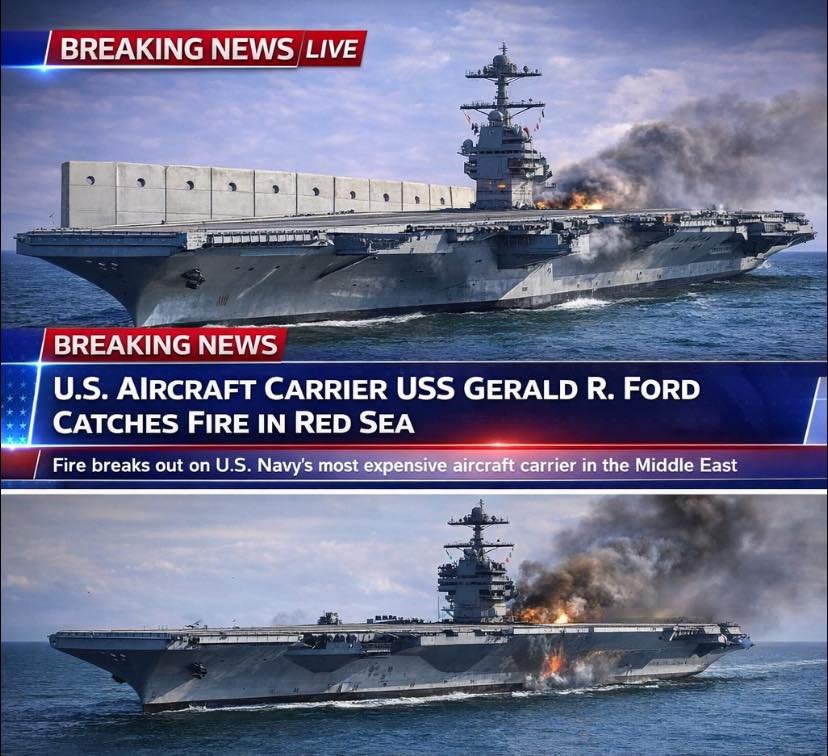
The vast waters of the Red Sea have once again become the center of global attention after reports emerged of a fire incident aboard the USS Gerald R. Ford, the most advanced and expensive aircraft carrier ever built by the United States Navy. The vessel, often described as the crown jewel of American naval power, was conducting operations as part of the U.S. military presence in the Middle East when the unexpected blaze reportedly broke out, sending a wave of concern through defense circles, international observers, and the millions of people who follow developments in one of the world’s most volatile regions.
According to early reports, the fire began in a technical support and maintenance-related area of the carrier during ongoing operations. Although official statements emphasized that the blaze was quickly brought under control by highly trained onboard fire response teams, the very fact that a fire erupted aboard such a sophisticated warship instantly ignited public interest and renewed debate about the pressures facing U.S. naval forces deployed in tense maritime corridors.
Initial information indicated that two sailors were injured during the incident, though both were expected to recover. Authorities stressed that the injuries were not life-threatening, and that the carrier’s propulsion, weapons, and combat systems had not been affected. Most importantly, officials maintained that the USS Gerald R. Ford remained fully mission-capable and would continue carrying out its role in the region without interruption.
Still, even with those assurances, the symbolic impact of the fire was impossible to ignore.
For many Americans, the USS Gerald R. Ford is not just another military vessel. It is the embodiment of technological superiority, industrial ambition, and strategic deterrence. Named after the 38th president of the United States, the carrier represents a new generation of naval warfare, equipped with cutting-edge systems, advanced radar, electromagnetic aircraft launch technology, and a design intended to shape the future of maritime dominance for decades to come. Every deployment by the ship is watched closely not only by allies, but also by rivals, adversaries, and analysts eager to interpret any sign of strength, weakness, or vulnerability.
That is why news of a fire onboard—even one officially described as limited and contained—immediately traveled far beyond military channels. Headlines spread quickly across social media, alternative news pages, defense forums, and international outlets. In a digital environment where every ship movement and every operational incident can be magnified within minutes, the story became larger than the flames themselves.
Questions began to swirl almost immediately. How serious was the fire really? Was it truly an isolated technical incident, or did it expose hidden stress within one of the Navy’s most ambitious warships? Could the event signal the intense wear and strain being placed on deployed carriers in a region marked by escalating geopolitical tension, militant threats, and constant operational readiness?
Those questions grew louder because of where the incident occurred.
The Red Sea has become one of the most strategically sensitive waterways on Earth. Linking the Mediterranean Sea to the Arabian Sea through the Suez Canal and Bab el-Mandeb Strait, the region is vital for energy shipments, military transit, and global commerce. In recent years, and especially in times of heightened regional instability, U.S. naval deployments in these waters have carried enormous significance. The presence of a carrier strike group is never merely symbolic. It is a statement of readiness, influence, and strategic intent.
When a vessel like the Gerald R. Ford experiences even a relatively contained onboard emergency in such an environment, the world pays attention not only because of the human dimension, but because of the geopolitical implications. Allies seek reassurance. Adversaries study every detail. Military analysts compare the incident with prior cases across naval history, asking whether routine operations are becoming harder to sustain under the burden of constant readiness and prolonged deployment.
From the Navy’s perspective, onboard fires—while serious—are among the many hazards sailors are trained extensively to confront. Life at sea, especially aboard massive aircraft carriers, involves a constant relationship with risk. Thousands of personnel work in tightly coordinated spaces packed with machinery, fuel systems, electronics, aircraft equipment, maintenance zones, and living quarters. In such an environment, even a minor spark can become dangerous if not addressed immediately. That is why naval crews drill relentlessly for emergencies ranging from flooding and mechanical breakdowns to fire and battle damage. The swift suppression of the blaze, according to officials, was meant to demonstrate exactly that level of readiness.
And yet, the public imagination rarely stops at the official line.
Whenever a military superpower’s most valuable asset suffers an incident, speculation fills the gaps before facts can fully settle in. Some observers online suggested sabotage without presenting evidence. Others hinted at hidden system fatigue or questioned whether the vessel’s cutting-edge systems have introduced new maintenance complexities. There were even voices using the story to fuel broader narratives about American overstretch in the Middle East. None of those theories were confirmed, but their rapid spread reflected a reality of the modern information age: military incidents now unfold in two arenas at once—the physical world and the digital battlefield of perception.
What cannot be ignored, however, is the human side of the event.
For the two sailors injured in the fire, this was not a headline or an abstract defense issue. It was a moment of real danger. Behind every carrier deployment are thousands of men and women living and working under conditions that most civilians can barely imagine. They operate around the clock, often in extreme heat, far from home, in one of the most demanding environments on Earth. Fires at sea are especially feared because there is no easy escape, no outside fire department rushing in from down the street, and no margin for panic. Every second matters, and every crewmember depends on discipline, training, and the actions of those around them.
That the injuries were not life-threatening offered relief, but it did not erase the seriousness of what happened. Incidents like this serve as stark reminders that even on the most advanced warships in the world, danger remains constant, immediate, and unforgiving.
The Navy’s insistence that the ship remains fully operational is likely intended to send a message on several levels. On the internal level, it reassures service members and their families that command and control remain intact. On the strategic level, it signals to allies and adversaries alike that the U.S. carrier force remains ready and undeterred. And on the public level, it attempts to contain the narrative before speculation turns a manageable onboard emergency into a perceived strategic embarrassment.
That messaging matters because the USS Gerald R. Ford carries enormous symbolic weight. As the lead ship of its class, it has often stood at the center of discussions about modernization, defense spending, readiness, and the future of naval power. Supporters see it as an unmatched technological marvel capable of redefining carrier operations. Critics, meanwhile, have sometimes pointed to the complexity and cost of next-generation systems as reasons for concern, particularly when delays or technical questions emerge. In that context, any incident aboard the ship becomes part of a much larger conversation about whether military innovation is delivering on its promises.
For defense analysts, the incident may ultimately be remembered less for the fire itself and more for what followed: the transparency of the response, the speed of factual clarification, and the degree to which the event either fades into routine naval history or becomes another reference point in debates over readiness and resilience. Much will depend on what subsequent details reveal. Was the cause purely accidental? Was equipment failure involved? Were maintenance protocols followed? Did the crew’s response confirm operational excellence, or will investigators identify preventable vulnerabilities?
Those answers may take time. What is certain is that the event has already left an impression.
In a year defined by regional instability, maritime tension, and constant scrutiny of American military posture, even a brief fire aboard the Navy’s flagship carrier carries outsized significance. It reminds the world that power projection is not a theatrical display but a living, moving, fragile system dependent on people, machinery, and discipline under pressure. It reminds the public that behind every image of an imposing aircraft carrier cutting through contested waters lies a far more complex reality—one where even the strongest vessels can face sudden moments of danger.
For now, the USS Gerald R. Ford continues its mission, its crew pressing forward after a scare that could have been far worse. Officially, the ship remains capable, the injuries are being treated, and operations continue. But the image of smoke rising from America’s most advanced carrier in the middle of one of the world’s most dangerous maritime theaters is not one that will fade quickly.
It is an image that lingers because it captures so much at once: the power of modern warfare, the vulnerability hidden within that power, and the thin line between control and crisis at sea.
And in that lingering image, the world sees more than a fire.
It sees a warning that even the most formidable machines ever built are still, in the end, dependent on the humans who sail them through uncertain waters.