

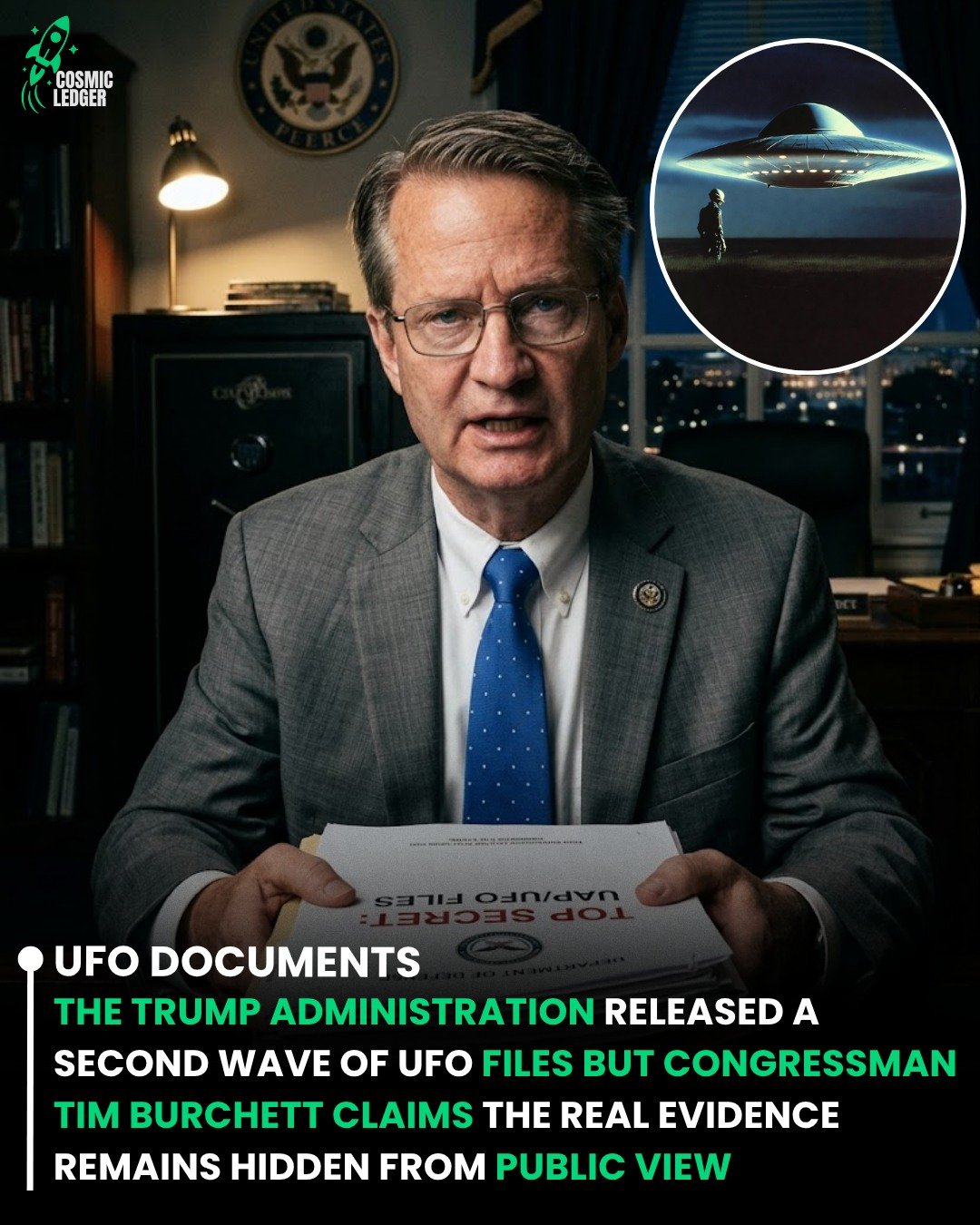
The debate over UFOs and government secrecy has erupted once again after the Trump administration released a second wave of long-awaited UFO files, reigniting public fascination with unidentified aerial phenomena and raising fresh questions about what authorities may still be withholding.
The newly released documents, published as part of ongoing transparency initiatives, contain reports, videos, intelligence assessments, and historical records spanning decades. While the disclosure was promoted as another step toward informing the public about unexplained aerial encounters, critics argue that the most important information remains locked behind classified walls.
Among the loudest voices expressing frustration is Congressman Tim Burchett, one of the most outspoken advocates for UFO transparency in Washington. Burchett sharply criticized the release, calling it a “deep state classic” and suggesting that the public is once again being shown only a carefully selected portion of the evidence.
According to Burchett, many of the files focus on incidents that can be explained through conventional means, including atmospheric effects, equipment anomalies, or ordinary aircraft activity. While acknowledging that some cases remain intriguing, he argued that the most compelling material involving alleged recovered craft, advanced technologies, and unexplained capabilities was notably absent from the disclosure.
His comments have fueled speculation among UFO researchers and transparency advocates who believe governments possess far more information than has been publicly acknowledged.
The files released on May 22, 2026, include video footage and reports documenting unusual aerial events observed by military personnel and intelligence agencies. Several incidents describe objects displaying sudden acceleration, dramatic changes in direction, unusual formations, and flight characteristics that appear difficult to reconcile with known aircraft technology.
In multiple reports, witnesses describe objects moving at extraordinary speeds without visible propulsion systems. Others detail encounters involving craft that appeared capable of hovering motionless before accelerating almost instantaneously. Such observations continue to challenge conventional explanations and have become central to discussions surrounding advanced aerospace technologies.
While skeptics caution that sensor errors, optical illusions, and incomplete data can create misleading impressions, proponents argue that certain cases remain difficult to dismiss and deserve further scientific investigation.
Perhaps even more fascinating are the historical records included in the release. Among the newly available documents are Cold War-era reports originating from Sandia Base in New Mexico, where military observers documented unexplained aerial activity near sensitive defense installations.
The release also contains intelligence assessments connected to former Soviet Union investigations into unidentified aerial phenomena. These records suggest that interest in unexplained objects was not limited to the United States but was actively studied by rival superpowers during periods of intense geopolitical tension.
Adding another layer of intrigue, the files include archived NASA communications and audio recordings associated with Apollo-era missions. Although many of these materials have been publicly discussed in various forms over the years, their inclusion provides additional historical context for researchers examining the evolution of government interest in unexplained aerial events.
For supporters of full disclosure, the latest release represents both progress and disappointment. On one hand, the publication of thousands of pages of records demonstrates a growing willingness to discuss topics that were once dismissed or heavily stigmatized. On the other hand, critics argue that the continued classification of key information prevents the public from obtaining a complete understanding of what governments may actually know.
The controversy highlights an ongoing tension between national security concerns and public demands for transparency. Intelligence agencies maintain that certain information must remain classified to protect sources, methods, and sensitive technologies. Transparency advocates counter that excessive secrecy only fuels suspicion and undermines public trust.
As debates continue, one fact remains clear: public interest in UFOs has never been stronger. Whether the unexplained objects represent advanced human technology, misunderstood natural phenomena, foreign aerospace programs, or something entirely unknown, the questions surrounding them continue to captivate millions around the world.
For now, the second wave of UFO files offers another glimpse into a mystery that has persisted for generations. Yet if Congressman Burchett and other disclosure advocates are correct, the most extraordinary revelations may still remain hidden from public view.