

For years, unidentified aerial phenomena have occupied a strange place in American public discourse—dismissed by skeptics, debated by researchers, and quietly investigated behind closed government doors. But now, according to one of Congress’s most outspoken voices on the issue, the conversation has entered an entirely new phase.
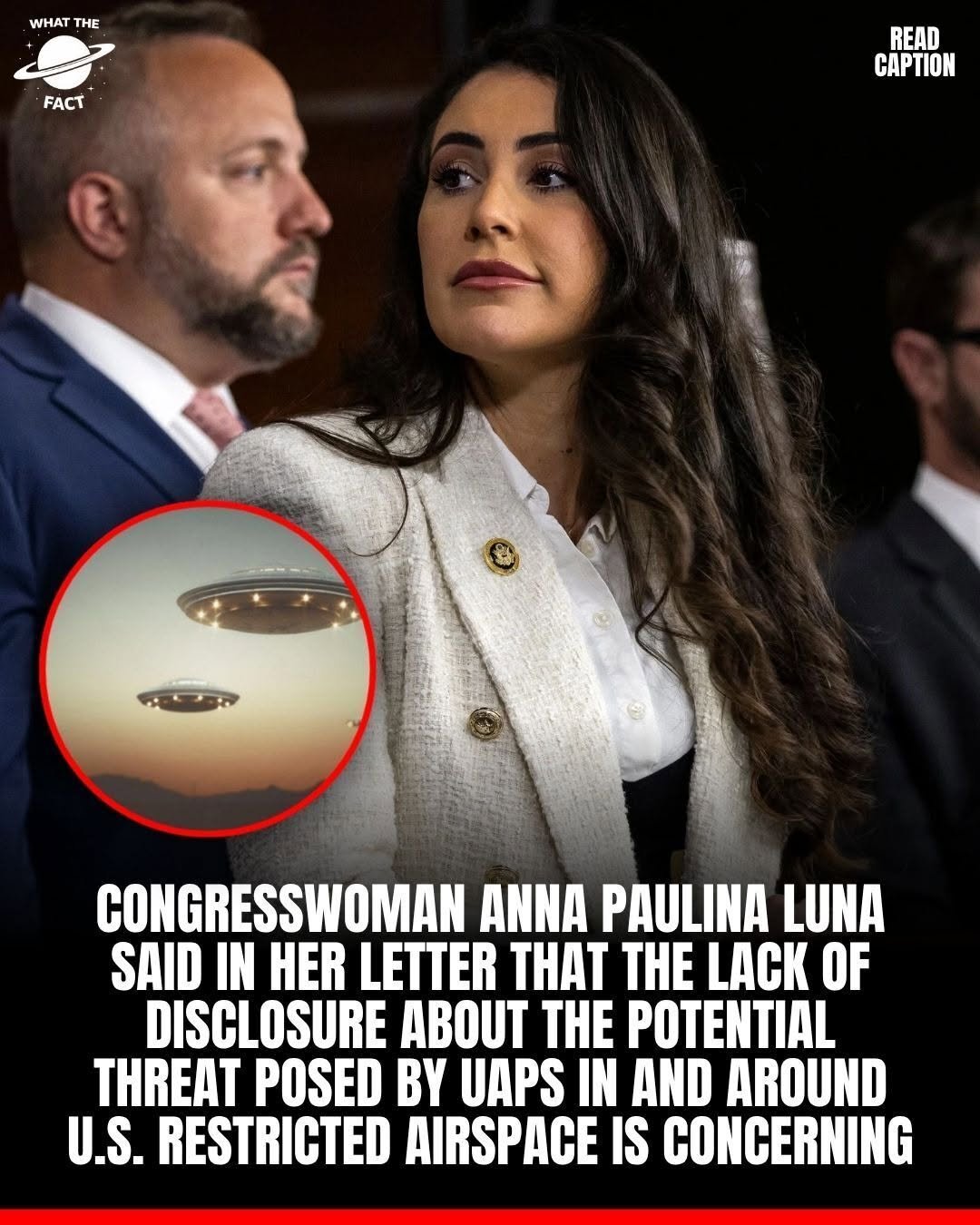
In a move that has ignited speculation across the disclosure community, Congresswoman Anna Paulina Luna reportedly committed one of the strongest written statements ever associated with congressional UAP oversight. Rather than describing the issue as hypothetical or merely worthy of investigation, she characterized unidentified aerial phenomena operating in restricted American airspace as a “very real” national security concern.
Observers immediately noted the significance of the wording.
Unlike previous political statements that carefully relied on terms such as possible, potential, or alleged, this language appeared unusually direct. Supporters argued that the phrasing suggested a level of confidence rarely seen from elected officials discussing unexplained aerial incidents.
The statement reportedly appeared in an official congressional communication urging greater transparency regarding incidents occurring near some of America’s most sensitive locations.
Restricted airspace is not ordinary sky.
It includes military bases, nuclear facilities, strategic command centers, weapons testing ranges, and other locations protected by some of the world’s most sophisticated defense systems. Unauthorized aircraft entering these areas typically trigger immediate responses from multiple federal agencies.
Yet reports of unidentified objects allegedly operating within these zones have continued to fuel debate among lawmakers and investigators alike.
According to disclosure advocates, Luna’s position stems from extensive access to classified government briefings. They claim she has reviewed dozens of confidential Pentagon videos documenting unusual aerial encounters and has examined classified materials unavailable to the public.
Those claims remain the subject of significant public debate and have not been independently verified.
Even so, supporters argue that her willingness to place her concerns into an official written document represents an important symbolic moment.
“If lawmakers are confident enough to describe the issue in formal correspondence,” one commentator remarked, “then the public naturally begins asking what information led them to that conclusion.”
Questions surrounding unidentified aerial phenomena have intensified in recent years as congressional hearings, military pilot testimony, and declassified Navy footage have pushed the topic further into mainstream discussion.
What once existed primarily in documentaries and internet forums has gradually become the subject of inspector general complaints, intelligence briefings, and bipartisan congressional oversight.
Still, critics urge caution.
Many defense experts emphasize that unexplained does not necessarily mean extraterrestrial. Unknown radar signatures, classified foreign technology, atmospheric effects, sensor limitations, or other conventional explanations may account for at least some reported incidents.
Nevertheless, proponents of greater transparency insist that uncertainty itself is precisely why more information should be released.
If unidentified objects are repeatedly appearing over sensitive military installations, they argue, Americans deserve to understand whether the phenomenon represents advanced surveillance technology, intelligence failures, foreign adversaries, or something that current defense systems cannot yet explain.
As public interest continues to grow, pressure has reportedly increased on federal agencies to release additional documentation and clarify what officials know—and just as importantly, what they do not.
Whether future disclosures ultimately reinforce extraordinary claims or point toward more conventional explanations remains unknown.
But in this fictional scenario, one thing has become impossible to ignore.
The debate is no longer confined to anonymous whistleblowers or leaked videos circulating online.
It has reached official government correspondence.
And according to the dramatic narrative, a member of Congress has decided that describing the issue as merely “alleged” is no longer enough.