

For decades, rumors about secret government UFO evidence have circulated through intelligence agencies, military circles, and public discourse. Now, a sitting member of Congress is adding fuel to one of the most controversial debates in modern history.
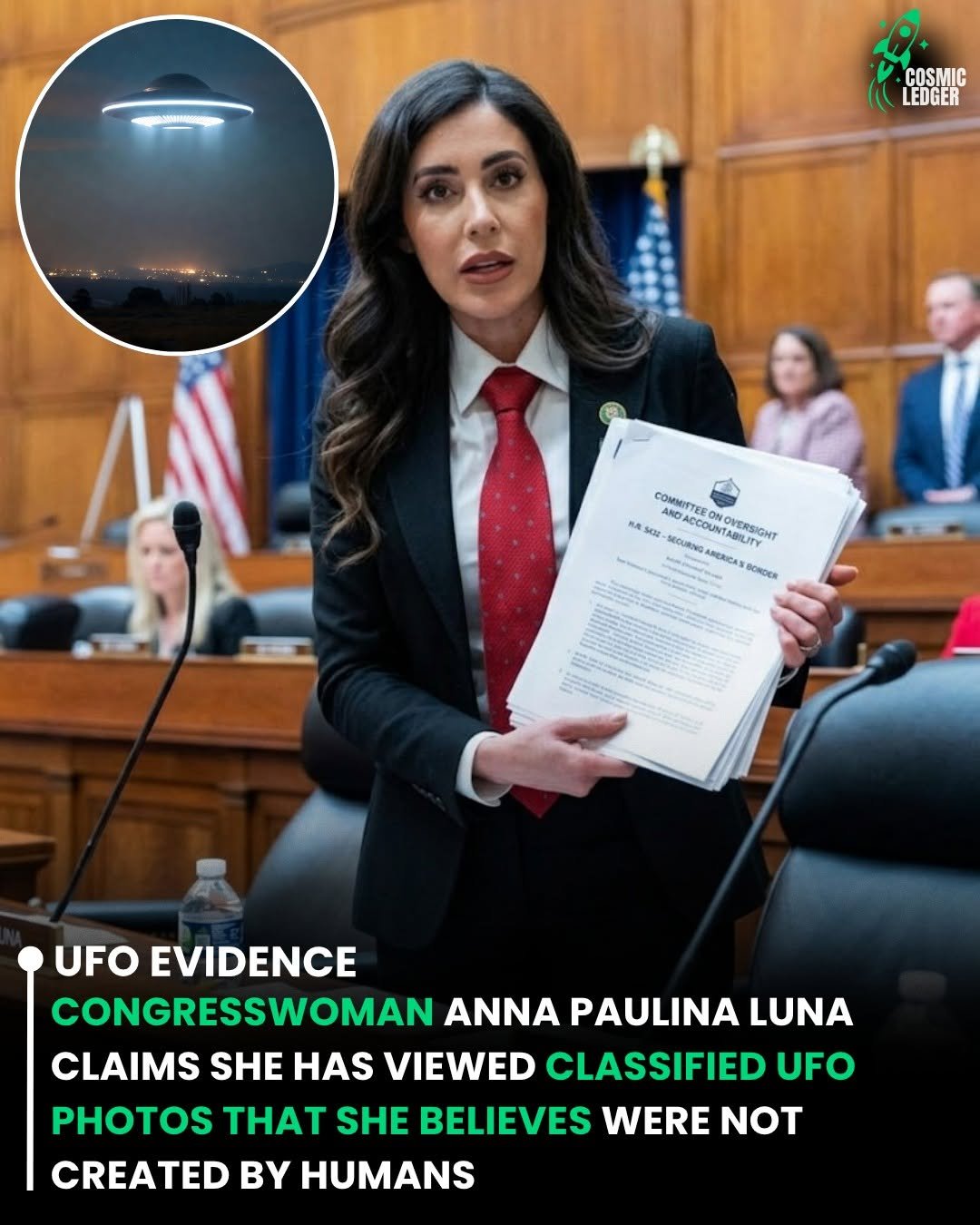
U.S. Congresswoman Anna Paulina Luna recently made headlines after revealing that she has personally viewed classified UFO photographs that she believes were not created by human beings. Her comments have reignited public fascination with unidentified aerial phenomena (UAPs) and raised new questions about what information may still be hidden from public view.
According to Luna, the images she reviewed contained objects that appeared beyond the capabilities of known human technology. While she stopped short of providing specific details due to classification restrictions, her assessment was clear: what she observed did not appear to originate from conventional human engineering.
Even more intriguing was her discussion of terminology allegedly used within certain government and intelligence circles. Luna stated that some officials refer to these mysterious entities or phenomena as “interdimensional beings,” a phrase that has increasingly surfaced in conversations surrounding advanced UFO investigations.
The concept of interdimensional beings goes beyond the traditional extraterrestrial hypothesis. Rather than visitors traveling across vast distances from another planet, the theory suggests that some unexplained phenomena could originate from realities or dimensions that exist alongside our own but remain largely inaccessible to human perception.
While such ideas have long existed at the fringes of scientific and philosophical discussion, they have gained greater attention in recent years as government officials, military witnesses, and intelligence personnel have become more willing to discuss unusual encounters and unexplained observations.
Supporters of greater UFO disclosure argue that Luna’s statements are significant because they come from an elected official with access to classified briefings. To them, her comments represent another indication that government insiders are encountering evidence they cannot easily explain through conventional means.
Many disclosure advocates believe that lawmakers who have reviewed restricted materials possess a broader understanding of the phenomenon than the general public. As more members of Congress speak openly about their experiences with classified information, calls for transparency continue to grow.
However, skeptics caution against drawing definitive conclusions from such statements alone.
Experts note that the existence of unusual photographs does not automatically prove extraterrestrial or interdimensional origins. Throughout history, images initially perceived as extraordinary have later been attributed to experimental technology, optical effects, atmospheric phenomena, or simple misinterpretations.
Without public access to the photographs themselves, independent analysis remains impossible. Critics argue that extraordinary claims require extraordinary evidence and that classified material, by its very nature, cannot be thoroughly evaluated by outside experts.
Still, Luna’s remarks have intensified curiosity about what evidence government agencies may possess behind closed doors.
If lawmakers with security clearances genuinely believe that some recorded objects are not human-made, the public naturally wonders what additional information remains hidden within classified archives. Are there more photographs, videos, sensor recordings, or intelligence assessments that have yet to be released? And if so, what conclusions have officials reached after examining them?
These questions sit at the heart of the ongoing disclosure movement, which seeks greater transparency regarding unidentified aerial phenomena and the government’s historical investigations into them.
The broader UFO discussion has evolved dramatically over the past decade. Once dismissed as a fringe topic, UAP investigations have become the subject of congressional hearings, military reports, and official government inquiries. Former intelligence officers, pilots, and defense personnel have increasingly shared accounts of encounters with objects exhibiting unusual flight characteristics and behaviors that challenge conventional explanations.
Against this backdrop, Luna’s comments are likely to attract significant attention from both supporters and critics of disclosure efforts.
Whether her observations ultimately point toward advanced unknown technology, misunderstood natural phenomena, classified human programs, or something even more extraordinary remains uncertain. What is clear is that statements from elected officials continue to keep the debate alive and ensure that public interest in the mystery shows no sign of fading.
For now, the classified photographs remain hidden from public view. Yet Luna’s assertion that they appear “not human-made” has once again pushed one of the world’s most enduring mysteries into the spotlight.
As demands for transparency grow and more government insiders share their perspectives, the conversation surrounding UFOs, interdimensional theories, and the possibility of non-human intelligence is likely to remain one of the most fascinating and controversial subjects of our time.