On May 4, 1945, somewhere off Okinawa, a Japanese aircraft came down toward the American escort carrier USS Sangamon. The ship’s guns opened fire. The aircraft missed by roughly 25 feet. For a fraction of a second, the distance between survival and destruction was little more than the width of a street. Yet that photograph, blurred by darkness and preserved in American naval archives, would become one of the many frozen moments through which the Second World War can still be seen today.
But photographs of war rarely tell the whole story. Sometimes the most important detail is not the aircraft in the sky, the tank in the street, or the ruined building in the background. It is the person standing beside it. A prisoner carrying another prisoner. A family waiting with luggage. A child caught inside a city divided by walls. A soldier sharing food. A crowd celebrating the end of a war that had already taken years from their lives.
The photographs left behind from the 1930s and 1940s can look strangely quiet today. They are black and white. The people rarely move. The streets seem distant. Yet behind many of those images lies a world being transformed by a conflict on a scale few generations had ever experienced.
And sometimes, to understand what the war meant, we have to stop looking at the battlefield itself.
We have to look at the people who were forced to live through it.
In the Philippines, the road became a place of suffering long before the war there was over. On April 9, 1942, American and Filipino forces on the Bataan Peninsula surrendered after months of fighting under terrible conditions. Their supplies had been exhausted, disease was widespread, and the soldiers had survived on severely reduced rations. After the surrender, prisoners were forced to march for miles under brutal conditions with little food, water, or rest.
One photograph from May 1942 shows American prisoners using improvised litters to carry fellow soldiers who had collapsed along the road. The image is remarkably simple. There is no dramatic battlefield in the background. No aircraft. No tanks. Just exhausted men carrying other exhausted men.
That simplicity is precisely what makes it difficult to forget.
The Bataan Death March is remembered for the suffering endured by prisoners, but photographs like this also reveal another dimension of captivity: the instinct to continue helping another person even when one’s own strength was disappearing.
The men carrying the improvised litters were themselves prisoners. They had little control over where they were going or what would happen next. Yet the photograph captures an act that required no military order and no political ideology.
One person had fallen.
Others carried him.
The war had reduced them to prisoners, but it had not completely erased their humanity.
Thousands would die during and after the march. The historical record makes clear that the disaster was not simply the consequence of combat. Hunger, disease, exhaustion, lack of water, and brutal treatment all contributed to the deaths. The march became one of the most notorious episodes of the Pacific War.
And yet the photograph of the makeshift litter does not show an abstract number.

It shows people.
That distinction matters.
Because as the war expanded, millions of human beings would increasingly appear in official records as numbers, categories, prisoners, refugees, civilians, soldiers, or populations. Photographs sometimes returned those numbers to human form.
Nowhere is that transformation more painful than Warsaw.
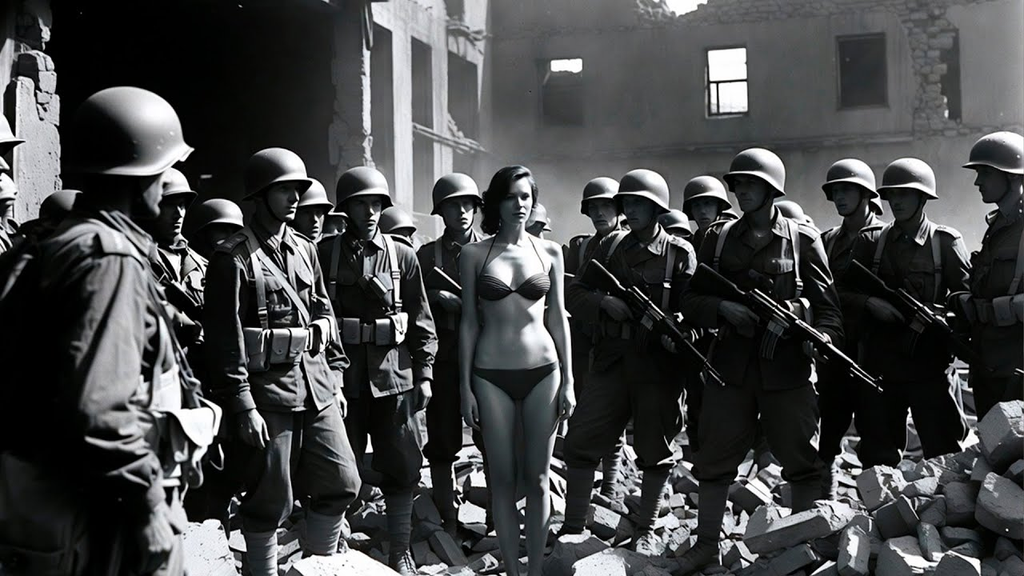
In 1940, German authorities established the Warsaw Ghetto and forced Jewish residents of the city into a confined area. By November, the ghetto was sealed. A wall separated it from the rest of Warsaw. At its height, the population approached half a million people, crowded into an extraordinarily small area.
Photographs of the wall can appear almost ordinary at first glance.
Brick.
Streets.
People walking past.
Buildings.

But the wall was not simply architecture. It was an instrument of separation and confinement. German authorities forced Jewish residents into the ghetto and guarded the boundaries to prevent movement between the enclosed district and the rest of Warsaw.
The significance of such photographs becomes clearer when we remember what was happening beyond the frame.
Inside the ghetto, overcrowding, inadequate food, disease, and starvation became part of daily life. The ghetto was eventually transformed into a place from which mass deportations were carried out. From July to September 1942, German SS and police units, assisted by auxiliaries, deported Jews from Warsaw to the Treblinka killing center.
So a photograph of a wall is never merely a photograph of a wall.
It is a record of a political decision made physical.
A boundary became a prison.
A neighborhood became a confined population.

And eventually, the photographs and documents left behind would become evidence of crimes committed on a scale that was difficult for the outside world to comprehend.
This is one of the reasons historical photographs require caution. A photograph can show what existed. It cannot always explain everything that happened outside its frame.
That is where historical records become essential.
The wall can be seen.
The documents explain why it was there.
The testimonies explain what life inside meant.
And the photographs preserve fragments of a world that no longer exists.
Across the Atlantic, the war was changing civilian life in a different way.
In the United States, people of Japanese ancestry were forcibly removed from their homes and sent first to temporary assembly centers and then to incarceration camps. The National Archives records that approximately 122,000 men, women, and children were forcibly moved to assembly centers during 1942.
A photograph of a young evacuee waiting with family baggage can therefore look deceptively ordinary.
A child.
A suitcase.
A bus.
A family waiting.
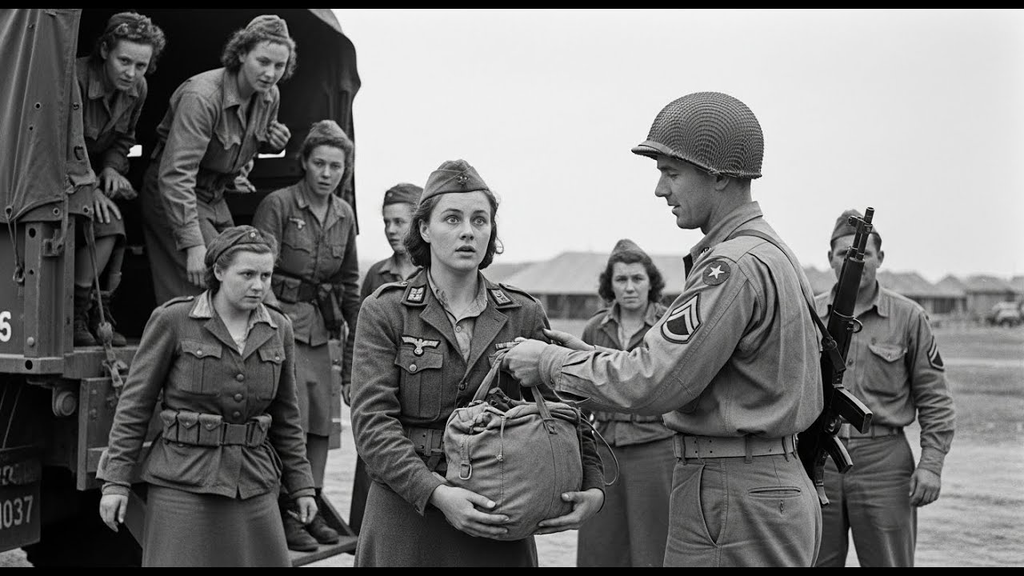
Nothing about the objects themselves explains the historical weight behind them.
But the luggage represented something larger than travel. Families were being ordered to leave their homes, often with severely limited time to prepare. They did not know exactly what the future would look like. Many had to leave behind homes, businesses, possessions, communities, and ordinary routines.
The image is quiet because forced removal does not always look dramatic.
Sometimes it looks like a family waiting beside its luggage.
The contrast is unsettling.
The same country fighting a global war against authoritarian powers was also imprisoning large numbers of its own residents because of ancestry.
That contradiction remains an important part of the historical record.
The photographs do not require us to invent emotions for the people in them. We do not need to claim that a particular child was thinking one specific thought. We can simply recognize the circumstances documented around the image.
A family was being removed.

A war had changed what citizenship, suspicion, and security meant in everyday life.
And the consequences would last long after the fighting ended.
By 1944 and 1945, the war had entered its final and most violent phase.
In Europe, Allied forces pushed across France and toward Germany. In the Pacific, American forces moved toward the Japanese home islands through increasingly intense fighting.
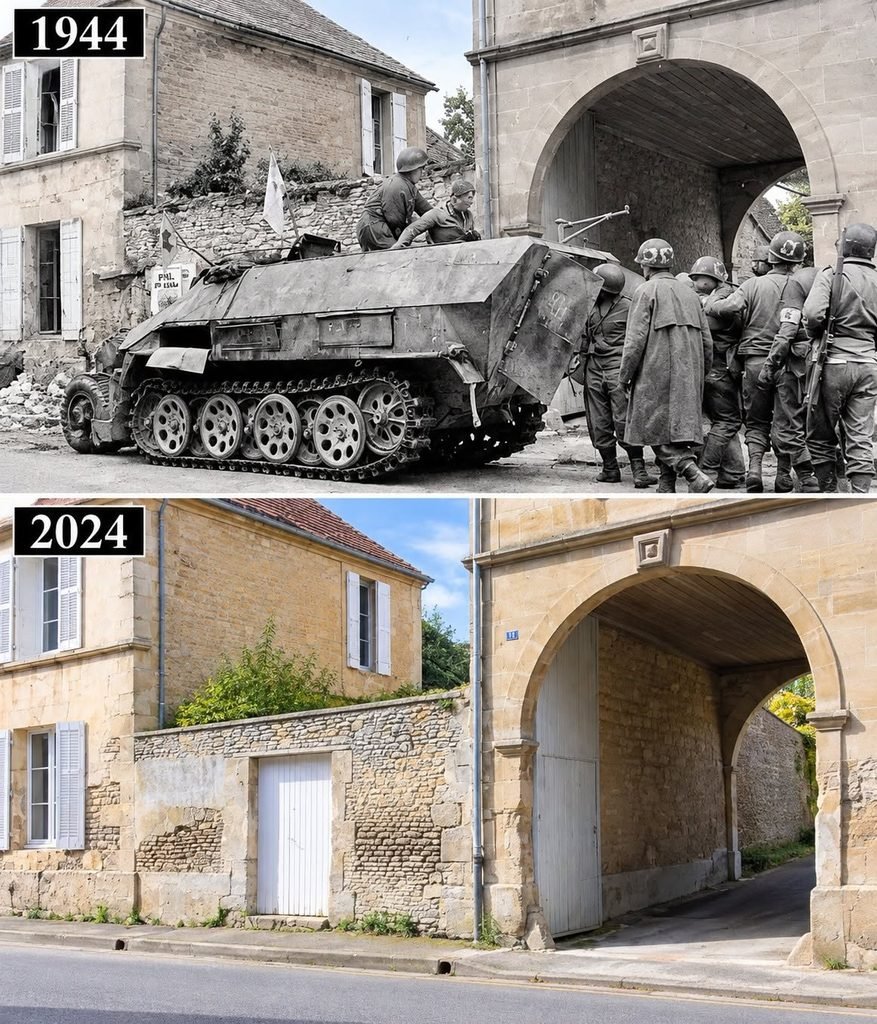
The photograph of a damaged Panther tank surrounded by French children belongs to this moment. In the source material, three boys are shown looking at a knocked-out German Panzer V Panther in Normandy on August 25, 1944.
The scene carries a strange mixture of destruction and curiosity.
The children are not shown operating the tank.
They are looking at it.
For them, a machine designed for war had become part of the landscape.
That is another recurring feature of historical photographs: objects built for destruction eventually become objects of curiosity.
A tank becomes a landmark.

A helmet becomes a memorial.
A ruined building becomes a photograph.
A weapon becomes an artifact.
The people who originally encountered these things as instruments of war could hardly have known how different their meaning would become decades later.
But in 1945, there was still fighting.
On May 4, 1945, the USS Sangamon was operating off Okinawa when Japanese aircraft attacked. One Kawasaki Ki-61 “Tony” fighter made a kamikaze attack and narrowly missed the carrier. Official U.S. Navy photographs preserve the moment. Another aircraft later struck the ship, causing serious damage and fires. The Sangamon suffered casualties and was ultimately repaired, but the attack demonstrated how dangerous the waters around Okinawa had become during the final months of the Pacific War.
One was the end of Nazi Germany.
The other was the beginning of a new division of Europe.
That contradiction would become increasingly visible in the years that followed.
The source material includes an image described as a newly constructed wall dividing Warsaw in 1940. Historically, that wall belongs to the Warsaw Ghetto and should not be confused with the later Berlin Wall, which was constructed in 1961. The distinction matters because photographs from different decades are often mixed together in popular collections. Historical memory becomes distorted when captions are treated as interchangeable with evidence.

The same caution applies to many other photographs in collections like these.
Some captions are accurate.
Some are incomplete.
Some contain uncertain identifications.
Others combine correct images with incorrect dates, names, or locations.
That is why the photograph alone cannot always be the final authority.
The archival record must remain the foundation.
And sometimes the most moving images are not the most famous ones.
One such image from the Pacific concerns an American officer and a kitten found near Mount Suribachi on Iwo Jima. The source material describes Marine Captain Edward Burkhard finding the kitten at the foot of Mount Suribachi in 1945, a place associated with some of the fiercest fighting of the Pacific War.
The small animal is almost painfully out of place in the surrounding history.
Mount Suribachi had become a symbol of battle.
Yet a kitten could still appear there.
That contrast is part of the strange visual language of wartime photography.
A battlefield does not stop being a battlefield because something innocent enters the frame.
Nor does innocence erase what happened there.
It simply reminds us that war takes place in a world that continues to contain ordinary life.
One image in the source material shows a soldier sharing food with two Dutch children in 1945.
The act itself is simple.
Food.
Two children.
A soldier.
But after years of occupation, hunger, displacement, and military conflict, an ordinary meal could carry meaning far beyond the food itself.
The war was ending.
The relationship between occupier and occupied was changing.
The future was beginning to open.
And yet the photograph does not tell us everything about what happened before or after it.
It simply freezes one moment.
That is the strength—and the limitation—of photography.
A photograph gives us a door.
History tells us what lies behind it.
In Europe, another image from 1945 captures the same transition in a different form: crowds celebrating the end of the war.
On August 14, 1945, people filled the streets of New York City after Japan’s surrender became known. Confetti covered the ground. Strangers gathered together.
One month after the atomic bombing of Hiroshima, Japan, photographs recorded a city transformed by destruction.
There is no need to make the image more horrifying than it already is.
The historical event speaks for itself.
The atomic bombings became one of the most consequential decisions of the twentieth century. They brought the war in the Pacific to its final stage, but they also introduced the world to the unprecedented destructive potential of nuclear weapons.
The photographs from Hiroshima are therefore not simply records of a wartime event.
They are warnings from the beginning of the nuclear age.
And then there is Berlin.
The war in Europe was over, but the struggle between the former Allies was already beginning to harden.
Germany had been divided into occupation zones, and Berlin itself, despite lying within the Soviet occupation zone, had also been divided among the four victorious powers.
In June 1948, the Soviet Union imposed a blockade on land routes into West Berlin. The Western Allies responded with an enormous airlift. From June 26, 1948, to September 30, 1949, aircraft delivered food, coal, medicine, and other supplies to the isolated city.
This was no longer World War II.
It was the Cold War.
But it was born directly from the aftermath of World War II.
The images of Berliners looking toward aircraft carrying supplies are therefore part of the same larger historical story.
The war had ended.
The consequences had not.
That is an extraordinary historical image even when no photograph is present.
Brick that once belonged to destroyed buildings became part of a runway.
Rubble became a foundation.
Destruction became material for reconstruction.
And the people who had survived the war now had to build a life after it.
The Soviet blockade eventually ended on May 12, 1949, although the airlift continued until September as the Western Allies built up reserves.
The photograph collection from which these stories emerge contains many other images: famous actors, unusual inventions, strange advertisements, ordinary families, soldiers, animals, streets, machines, political figures, and people caught in moments that seemed insignificant at the time.
But the World War II photographs have something in common.
They show a world in transition.
A prisoner carrying another prisoner.
A wall dividing a city.
A family waiting with luggage.
A tank abandoned on a road.
An aircraft attacking a carrier.
A soldier beside a child.
A kitten near a battlefield.
Crowds celebrating liberation.
Aircraft carrying food into a divided city.
None of these images, by themselves, explains the whole war.
Together, however, they reveal something that statistics often struggle to communicate.
And eventually, in the memories of those who survived.
That may be the most important lesson hidden inside old photographs.
The past does not always announce itself.
Sometimes it looks ordinary.
A family carrying luggage.
A soldier holding an animal.
A group of children looking at a tank.
A crowd standing in the street.
A plane approaching a ship.
A wall being built through a city.
Only when we understand the circumstances surrounding the photograph does its meaning become visible.
The Second World War ended in 1945, but its consequences did not disappear with the surrender documents.
The images therefore belong not only to the story of war.
They belong to the story of what humans did afterward.
Some photographs show destruction.
Others show survival.
Some record cruelty.
Others preserve small acts of kindness.
Some show political power.
Others show ordinary people simply trying to continue living.
The future was invisible to them.
Just as ours is invisible to us.
History often appears inevitable when viewed backward.
But it never felt inevitable to the people living through it.
For a prisoner on a road in the Philippines, the next mile mattered.
For a family carrying luggage in 1942, the next destination mattered.
Some content was generated using AI tools (including ChatGPT) and edited by the author for creativity, storytelling, and historical illustration purposes. Historical facts and key details should be verified against reliable historical sources. Any AI-generated or reconstructed visuals are intended for illustrative purposes and should not be interpreted as original historical photographs or archival evidence.
Để lại một bình luận