

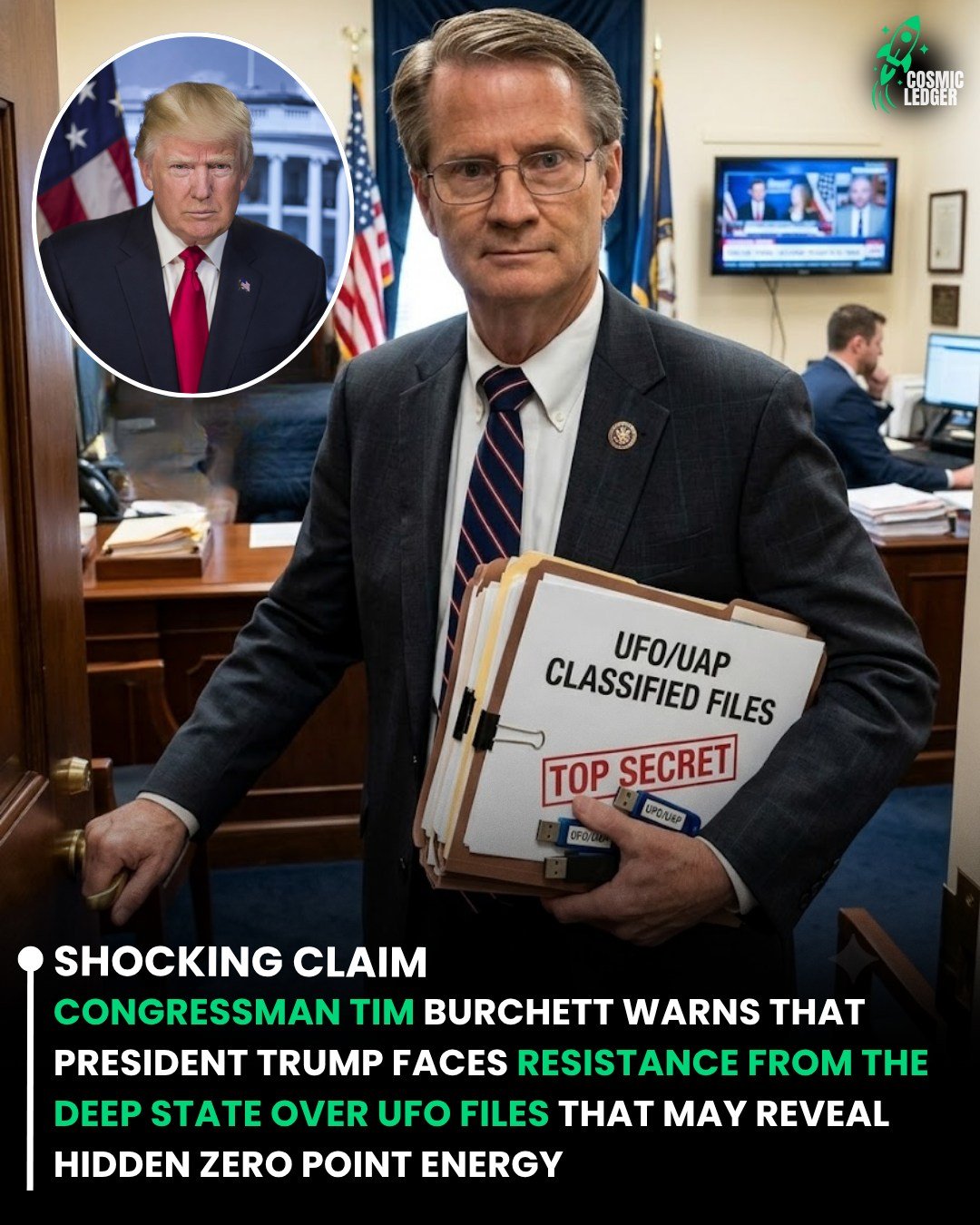
The debate surrounding UFO disclosure has entered a new and potentially explosive phase after Congressman Tim Burchett suggested that classified government files may contain information extending far beyond mysterious objects in the sky. According to Burchett, some of the hidden records could involve revolutionary technologies, including the long-discussed concept of Zero Point Energy, a theoretical energy source that many believe could transform civilization.
Burchett has become one of the most vocal advocates for government transparency regarding unidentified aerial phenomena. While he has repeatedly stated that he has never personally encountered extraterrestrial beings, he argues that the growing body of evidence presented by military personnel, intelligence officials, pilots, and whistleblowers points toward phenomena that deserve far greater public scrutiny.
The Congressman says his concerns are based on years of briefings, witness testimony, and access to information that raises questions about what federal agencies may know behind closed doors. According to Burchett, the issue is no longer simply about unusual lights in the sky. Instead, it has evolved into a broader investigation involving advanced technologies, national security concerns, and the possibility that critical discoveries have remained hidden from the public for decades.
One of Burchett’s most controversial claims involves what he describes as resistance from powerful elements within the federal government. He argues that certain intelligence organizations and bureaucratic structures have slowed efforts to release information related to UFO investigations. In public interviews, he has referred to what many call the “Deep State,” suggesting that entrenched institutions may be protecting sensitive information from elected officials and the public alike.
According to Burchett, the reluctance to release all relevant records may stem from concerns over public reaction. If the hidden information confirms technologies far beyond current scientific understanding, the implications could be enormous. Such revelations could potentially affect defense systems, aerospace industries, energy markets, and geopolitical power structures around the world.
Among the most intriguing aspects of Burchett’s statements is his reference to Zero Point Energy. Although largely theoretical within mainstream science, the concept proposes the existence of a vast reservoir of energy present throughout the vacuum of space itself. For decades, researchers, inventors, and UFO enthusiasts have speculated that advanced civilizations—or perhaps secret government programs—may have discovered ways to harness such energy.
If technologies connected to Zero Point Energy were ever proven to exist, the consequences could be revolutionary. Advocates argue that it could provide nearly limitless clean energy, dramatically reducing dependence on fossil fuels and reshaping the global economy. Skeptics, however, note that no verified evidence currently demonstrates a practical method of extracting usable energy from the quantum vacuum.
Burchett stops short of claiming that such technologies have been definitively recovered or replicated. Nevertheless, he suggests that classified UFO files may contain information that deserves independent examination and public debate. His comments have reignited speculation that some unexplained aerial phenomena could be linked to advanced propulsion systems operating far beyond conventional aerospace engineering.
The Congressman also points to numerous reports from military pilots who have described encounters with objects displaying extraordinary capabilities. Witnesses have reported craft accelerating instantly, changing direction without visible means of propulsion, hovering silently for extended periods, and performing maneuvers that appear inconsistent with known aircraft limitations.
These reports have become central to the modern UFO discussion, particularly after several military videos were officially acknowledged by government agencies. While many cases remain unresolved, officials continue to caution that unexplained does not automatically mean extraterrestrial. Nevertheless, the persistence of these incidents has fueled calls for greater transparency.
As public interest grows, pressure is increasing on federal agencies to release additional information. Supporters of disclosure argue that citizens deserve access to records funded by taxpayers and that excessive secrecy undermines trust in government institutions. Opponents counter that certain information must remain classified to protect intelligence sources, military capabilities, and national security interests.
Whether future disclosures will validate Burchett’s concerns remains uncertain. What is clear is that his statements have amplified public curiosity about what may still be hidden within classified archives. The possibility that UFO files could involve advanced energy systems, revolutionary propulsion technologies, or decades of undisclosed research has transformed the conversation from one focused solely on unidentified objects into a much broader debate about science, secrecy, and the future of human technology.
As calls for accountability continue to grow, many Americans are left asking the same question: if the government possesses information capable of changing our understanding of physics, energy, or even humanity’s place in the universe, how much longer can those secrets remain hidden?