

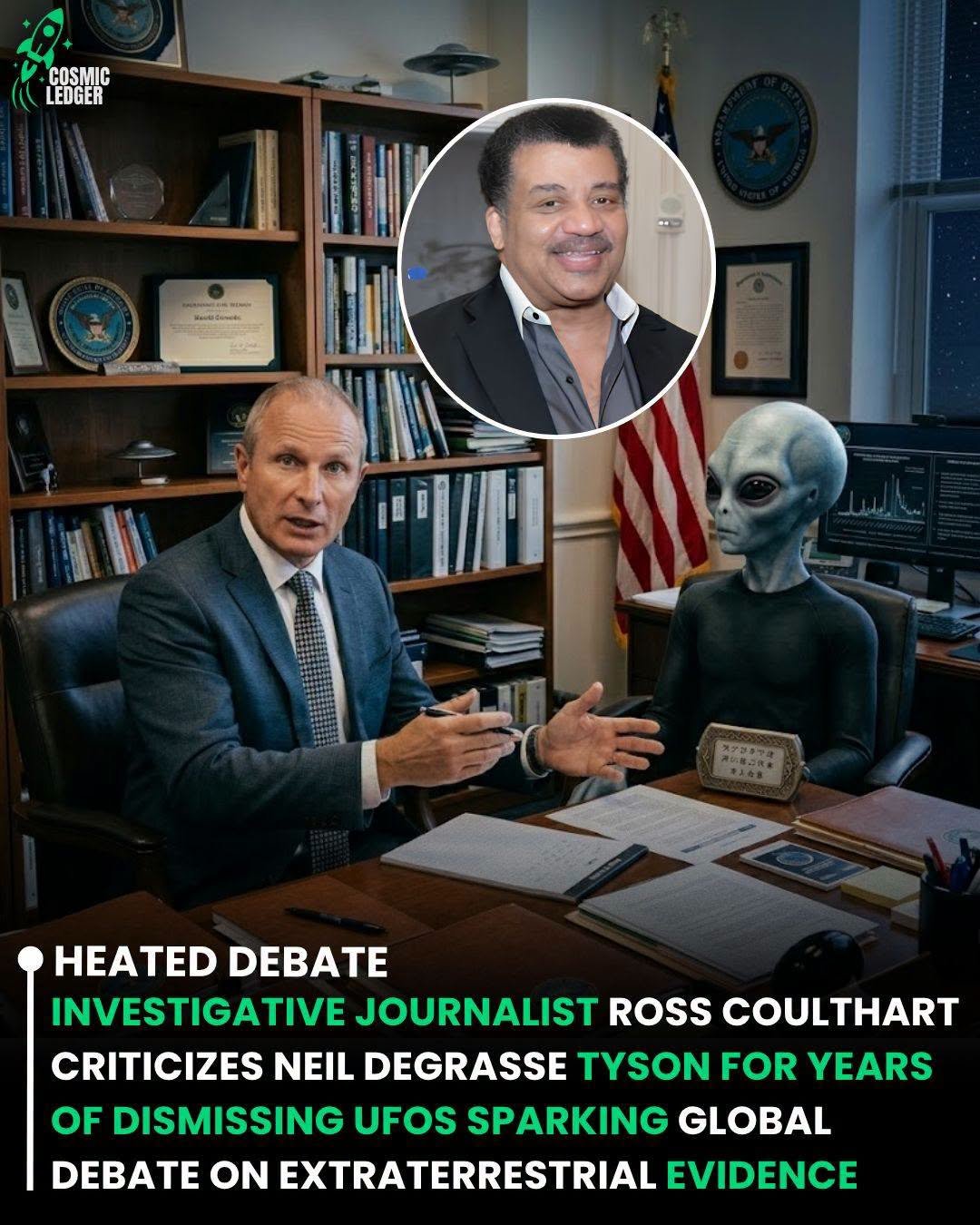
A growing clash between two of the most recognizable voices in the UFO and science communities has reignited one of the most controversial debates of the modern era. Investigative journalist Ross Coulthart has openly challenged celebrated astrophysicist Neil deGrasse Tyson, accusing him of spending years dismissing or ridiculing reports of unidentified aerial phenomena (UAP) without giving serious consideration to the growing body of testimony from military personnel, intelligence officials, and commercial pilots.
The exchange reflects a much broader cultural shift. For decades, UFO discussions were often pushed to the fringes of mainstream conversation, frequently associated with conspiracy theories or science fiction. Today, however, the landscape has changed dramatically. Government agencies have acknowledged investigating unexplained aerial incidents, classified briefings have reached lawmakers, and whistleblowers have alleged the existence of secret programs examining recovered technologies. While many of these claims remain unverified, they have fueled renewed public interest in whether longstanding assumptions deserve to be revisited.
Coulthart has become one of the most prominent investigative journalists covering the disclosure movement. Through interviews with former military officers, intelligence personnel, and government insiders, he argues that the subject has evolved beyond speculation. According to Coulthart, there is now enough credible testimony to justify serious scientific inquiry rather than automatic dismissal.
His criticism of Tyson centers not on skepticism itself but on what he views as an unwillingness to engage with accumulating evidence. Coulthart contends that influential scientific figures have a responsibility to investigate unusual reports objectively rather than dismissing them outright because they challenge conventional understanding.
Neil deGrasse Tyson, however, has consistently defended his position. Throughout numerous public appearances and interviews, Tyson has emphasized one of science’s most fundamental principles: extraordinary claims require extraordinary evidence. He argues that eyewitness accounts, even from highly trained professionals, cannot substitute for verifiable physical data that can be independently examined and reproduced.
From Tyson’s perspective, skepticism is not cynicism—it is an essential safeguard against misinformation. Throughout history, humanity has embraced many extraordinary claims that ultimately proved false. Science advances by demanding evidence, not by accepting compelling stories at face value.
Many scientists agree with Tyson’s cautious approach. They argue that unidentified does not automatically mean extraterrestrial. Atmospheric conditions, classified military technology, optical illusions, sensor limitations, and human perception can all contribute to reports that initially appear mysterious.
Yet supporters of disclosure believe the conversation has reached a turning point.
Recent congressional hearings have brought current and former government officials into the spotlight. Some have alleged that highly classified programs have recovered materials from unidentified craft or studied technologies that cannot easily be explained. Although these allegations have generated intense public interest, no publicly released evidence has conclusively verified claims of extraterrestrial origin.
For Coulthart and many disclosure advocates, however, the significance lies in the fact that these discussions are occurring openly within government institutions rather than remaining confined to internet forums or tabloid headlines. They argue that the willingness of lawmakers to investigate suggests the issue deserves careful attention.
Critics of Tyson also point to decades of military encounters involving experienced pilots. Numerous incidents involve radar tracking, infrared recordings, multiple eyewitnesses, and observations from advanced sensor systems. While none of these cases alone conclusively demonstrate extraterrestrial technology, disclosure advocates argue that the consistency of such reports over many years warrants deeper scientific investigation.
The debate ultimately extends beyond UFOs themselves.
At its core lies a philosophical question: How should science respond when credible witnesses report phenomena that existing theories struggle to explain?
One camp argues that skepticism protects society from false conclusions and sensationalism. The other contends that excessive skepticism can discourage investigation into potentially groundbreaking discoveries.
History offers examples supporting both perspectives. Scientific revolutions have often emerged after established assumptions were questioned, yet history is equally filled with extraordinary claims that failed under rigorous examination. Maintaining curiosity while insisting on evidence remains one of science’s greatest challenges.
Public interest in UAP has expanded dramatically over the past several years. Governments around the world have established investigative offices, released selected reports, and acknowledged that some encounters remain unexplained. Importantly, “unexplained” does not imply extraterrestrial origin—it simply indicates that available evidence has not yet produced a definitive conclusion.
As new information continues to emerge, journalists, scientists, lawmakers, and the public are all navigating unfamiliar territory. Investigative reporters like Ross Coulthart argue that transparency is essential, while scientists like Neil deGrasse Tyson maintain that any extraordinary conclusion must be supported by equally extraordinary evidence.
Whether future investigations ultimately reveal advanced human technology, misunderstood natural phenomena, or something entirely unexpected remains unknown. What is clear is that the conversation surrounding unidentified aerial phenomena has entered the mainstream in a way few would have predicted just a decade ago.
The ongoing exchange between Coulthart and Tyson symbolizes more than a personal disagreement—it reflects humanity’s enduring struggle to balance skepticism with curiosity. As investigations continue and additional information becomes available, the debate is likely to shape public understanding of one of the most fascinating and controversial mysteries of our time.
For now, the most responsible position remains one that welcomes rigorous investigation while recognizing the difference between intriguing claims and verified facts. The search for answers continues, and whatever those answers may be, they have the potential to reshape not only our understanding of the skies above us but also our place in the universe.