

SHREVEPORT, LA — Just weeks ago, Hunter Alexander was doing what he had done countless times before — climbing into dangerous conditions to restore power during a brutal winter storm.
Then, in a single moment, everything changed.
A devastating electrical accident left the young lineman fighting for his life.
Now, as another morning approaches, Hunter is preparing for something that has become all too familiar:
Surgery number six.
A Recovery Measured One Operation at a Time
In trauma medicine, recovery doesn’t come in dramatic leaps.
It comes in stages.
Difficult, exhausting, relentless stages.
For Hunter, that journey has been marked by repeated trips down the same hospital hallway — each one leading to another operation, another attempt to repair what the injury damaged.
Six times he has been prepared.
Six times he has gone under anesthesia.
And each time, the goal has remained the same:
Save as much function as possible.
The Night Before — A Rare Kind of Calm
Despite everything his body has endured, the update from his family brought something rare:
A good night.
Hunter rested.
He woke up stable.
Doctors changed the dressing on his right hand and were satisfied with what they saw.
In most situations, that might sound routine.
But in a recovery like this, it means something much bigger:
His body is holding the line.
Out of ICU — But Not Out of the Fight
Hunter has already passed one major milestone — he has been moved out of the intensive care unit.
Now recovering on a standard hospital floor, his condition is stable enough for continued care without constant ICU monitoring.
But stability does not mean safety.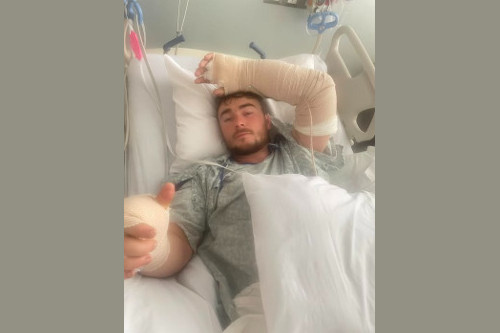
It means the fight has changed.
And tomorrow, that fight continues in the operating room once again.
Why So Many Surgeries?
Electrical injuries are not straightforward.
They don’t just damage what you can see.
They travel through the body — affecting muscles, nerves, and blood vessels deep beneath the skin.
And the damage doesn’t always appear all at once.
That’s why doctors must return again and again:
To remove tissue that reveals damage over time
To protect areas that can still recover
To maintain circulation and prevent further loss
Each surgery is part of a larger strategy.
Not a reset.
Not a failure.
A process of preservation.
What He’s Fighting For
Through all of it, one truth stands out.
Hunter doesn’t just want to recover.
He wants something specific.
Something deeply personal.
He wants his hands back.
The hands that worked through storms.
The hands that restored power to others.
The hands that defined his work, his independence, his life.
And every surgery brings him one step closer — or protects what remains.
A Journey Filled With Highs and Lows
Hunter’s recovery has not been easy.
There have been moments of fear.
Moments when complications threatened progress.
Moments when uncertainty felt overwhelming.
But there have also been signs of resilience:
Bleeding controlled
Circulation stabilizing
Wounds responding to treatment
Each small improvement tells a bigger story:
He is still fighting forward.
Another Morning, Another Fight
Tomorrow, Hunter will once again be wheeled into surgery.
The routine is familiar now.
The preparation.
The waiting.
The quiet tension in the room.
Doctors have their plan.
The medical team is ready.
And Hunter rests — gathering strength for what comes next.
Strength That Doesn’t Make Noise
Six surgeries in a matter of weeks would push anyone to the limit.
But Hunter continues.
No headlines. No dramatic speeches.
Just determination.
Just endurance.
Just the decision — again and again — to keep going.
Because sometimes, strength doesn’t look like a breakthrough.
Sometimes, it looks like this:
Showing up for surgery… one more time.
The Fight Continues
Hunter’s journey is far from over.
There will be more procedures.
More recovery.
More waiting.
But there is also something that has not changed since the beginning:
His will to get his life back.
And tomorrow, inside the operating room, that fight continues — steady, relentless, and unbroken.